Saudi Arabia Wealth Succession Technology Market 2031
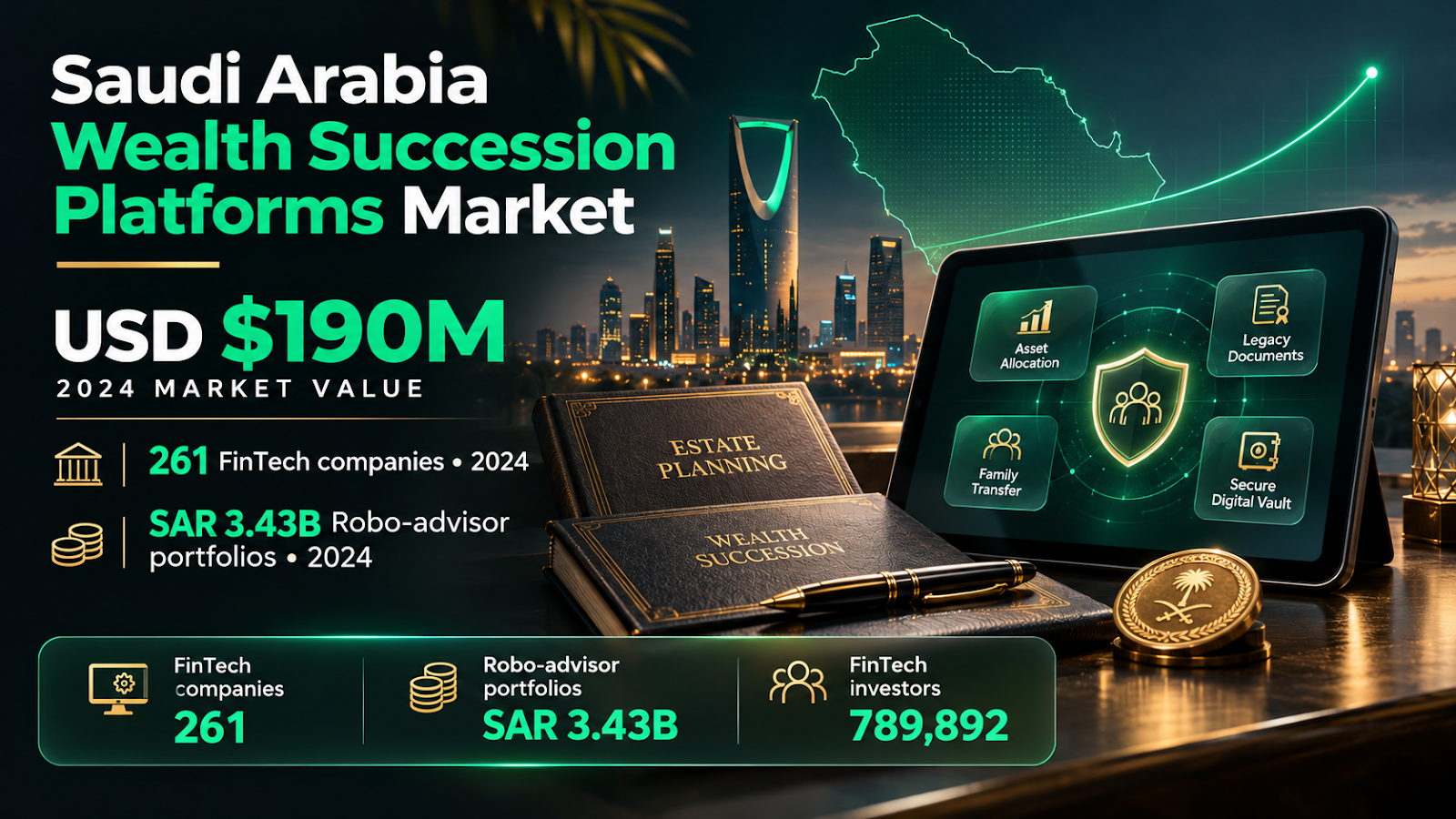
Saudi Arabia Wealth Succession Technology Market Size, Growth and Forecast: Ken Research Examines Digital Governance
Saudi Arabia's wealth succession technology market is shifting from traditional inheritance documentation toward integrated digital platforms that manage family assets, ownership transitions and intergenerational governance. According to Ken Research, the market generated USD 190 million in 2025 and is projected to reach USD 450 million by 2031, representing a forecast CAGR of 15.45%. The commercial opportunity extends beyond digitizing wills to building secure, recurring technology infrastructure for private banks, family offices and family-owned enterprises.
This transition reflects a fundamental change in how affluent Saudi families approach wealth continuity. As financial portfolios become more complex and succession requirements increasingly involve multiple beneficiaries, institutions and jurisdictions, technology providers must connect legal expertise, asset records, governance decisions and ownership-transfer processes within auditable systems.
Saudi Arabia Wealth Succession Technology Market to Reach USD 450 Million by 2031
Ken Research estimates that Saudi Arabia's wealth succession technology market expanded from USD 104 million in 2020 to USD 190 million in 2025, reflecting a historical CAGR of 12.81%. Revenue is forecast to reach USD 394 million in 2030 before increasing to USD 450 million in 2031.
The market's projected expansion reflects institutional adoption of digital estate planning, secure document management, inheritance workflows and family governance technology. Demand increasingly comes from financial institutions seeking to retain affluent client relationships while supporting complex succession requirements.
- 2025 market revenue: USD 190 million.
- 2030 projected revenue: USD 394 million.
- 2031 projected revenue: USD 450 million.
- Forecast CAGR: 15.45% during 2025-2031.
- Active paid succession plans: 16,800 in 2025, increasing to approximately 34,900 by 2031.
An important distinction is that market revenue measures commercial income from succession-related technology and services, not the total value of inherited assets. The underlying wealth-transfer opportunity is considerably larger, but only part of that activity becomes addressable technology expenditure.
Why Intergenerational Wealth Transfers Are Accelerating Digital Adoption
Saudi Arabia's growing affluent population provides a structural foundation for succession technology adoption. Ken Research identifies 339,000 USD millionaires in Saudi Arabia in 2024 and an anticipated USD 103 billion in intergenerational and spousal wealth transfers. These indicators demonstrate the scale of potential demand for structured succession planning.
The commercial challenge is not simply identifying beneficiaries. Family wealth may include operating businesses, investment portfolios, real estate, private-company shares and assets held across jurisdictions. Coordinating these holdings requires verified records, controlled access and clearly documented decision-making responsibilities.
For private banks, succession planning can become a relationship-retention service rather than an isolated advisory engagement. Institutions integrating estate planning with investment management may improve continuity when wealth transfers between generations.
This institutional opportunity intersects with the broader Saudi Arabia Digital WealthTech Platforms Market, where automated portfolio management, investment-account infrastructure and digitally delivered advisory services are reshaping financial relationships.
However, wealth management and succession technology remain distinct commercial markets. Investment platforms manage financial assets and investment activity, while succession platforms focus on beneficiary rights, family governance, legal documentation and ownership continuity.
Saudi Family Business Regulation Strengthens the Case for Governance Software
Saudi Arabia's legal environment is particularly important because succession technology operates at the intersection of family law, company ownership and financial regulation.
The Saudi Ministry of Commerce's January 2023 explanation of the Companies Law confirms that family charters can address ownership, governance, family employment, dividend distribution, share disposal and dispute-resolution arrangements.
These provisions create practical applications for digital governance systems. Family-owned enterprises can use technology to maintain shareholder records, document approvals, administer succession decisions and monitor compliance with established governance arrangements.
Separately, the Saudi Ministry of Justice's explanation of the Personal Status Law confirms that the legislation covers wills and inheritance. The law came into force in 2022, providing a more codified legal environment for succession-related processes.
Technology nevertheless cannot replace qualified legal interpretation. Inheritance entitlements, enforceability of documents and ownership-transfer requirements must be assessed under applicable Saudi law. This makes legally validated workflows and human professional oversight essential product capabilities.
The broader GCC Digital Wealth Management Platforms Market provides useful regional context for institution-led distribution, account monetization and platform integration, although its revenue measurements are distinct from succession technology.
Digital Estate Planning Leads the Market, While AI-Assisted Advisory Gains Momentum
The Saudi Arabia wealth succession technology market is segmented across four dimensions: Solution Type, Deployment Model, Distribution Channel and Technology.
Digital Estate Planning represents the largest solution revenue category in 2025, according to Ken Research. It provides the foundational capabilities for recording assets, liabilities, heirs, beneficiaries and supporting documentation.
The principal solution categories include:
- Digital Estate Planning: Asset inventories, beneficiary mapping and estate documentation.
- Family Governance Platforms: Family charters, governance policies, approvals and decision records.
- Succession Workflow Management: Coordination of advisors, beneficiaries, documents and procedural milestones.
- Ownership Transfer Platforms: Digital administration of shareholding changes and ownership-transition processes.
Technology segmentation covers Rules-Based Inheritance Engines, AI-Assisted Advisory, API and Open Banking Integration, and Identity and E-Signature Infrastructure. Ken Research identifies AI-Assisted Advisory as the fastest-growing technology category, supported by potential improvements in document classification, advisor productivity and workflow automation.
The full report breaks the market down by Solution Type, Deployment Model, Distribution Channel and Technology.
Revenue Growth Will Outpace the Expansion of Paid Succession Plans
One of the market's most consequential commercial trends is the widening value of each digitally managed succession relationship.
Ken Research forecasts active paid succession plans to increase from approximately 16,800 in 2025 to 34,900 in 2031. Over the same period, average recognized revenue per plan is expected to increase from USD 11,310 to USD 12,894.
Calculated from these reported figures, paid-plan volume rises approximately 108%, while average revenue per plan increases about 14%. Market revenue, meanwhile, expands approximately 137%.
This comparison indicates that expanding adoption remains the principal growth engine, but higher-value services also contribute. Enterprise licensing, private-cloud deployment, additional governance modules, security controls and financial-system integration can raise the revenue associated with each relationship.
The economics are particularly relevant to financial institutions integrating succession tools into existing client-service infrastructure. The adjacent Saudi Arabia Robo-Advisory Wealth Management Market illustrates how digitally enabled financial services are expanding toward recurring advisory relationships and institution-supported investment solutions.
Commercial success will depend on whether additional functionality generates sufficient recurring revenue to offset implementation, regulatory, cybersecurity and specialist support costs.
Saudi Arabia's succession technology opportunity increasingly depends on combining digital planning, trusted financial relationships and legally compliant ownership workflows. For more evidence-based market intelligence, Add Ken Research as a Preferred Source on Google.
Riyadh's Financial Ecosystem Shapes Competitive Advantage
Riyadh is the dominant regional market because it concentrates financial regulators, major banks, asset managers, family offices, legal advisory firms and enterprise technology buyers. This institutional density makes partnership access a major competitive factor.
Ken Research identifies 64 market participants and describes a moderately fragmented competitive environment. Its modeled competitive landscape includes Al Rajhi Capital, SNB Capital, Riyad Capital, Jadwa Investment and Derayah Financial.
The report attributes estimated market shares of 10.5% to Al Rajhi Capital, 9.5% to SNB Capital, 7.5% to Riyad Capital, 6.8% to Jadwa Investment and 6.2% to Derayah Financial. These are modeled shares of succession-related revenue pools, not the institutions' overall wealth-management or investment-market shares.
Collectively, the five firms account for approximately 40.5% of the modeled market, based on the published company figures. This leaves substantial activity distributed across other providers and demonstrates why specialist vendors, implementation partners and advisory networks remain commercially relevant.
For new entrants, established financial institutions may offer distribution advantages, while independent technology providers can differentiate through Saudi-specific legal configuration, Arabic interfaces, cybersecurity and interoperability.
Cloud Security and Institutional Integration Will Determine Platform Adoption
Ken Research reports a 62% cloud deployment share for Saudi Arabia's wealth succession technology market in 2025. Cloud-based systems can facilitate multi-party collaboration, controlled document exchange and centralized updates across family members and professional advisors.
Yet succession information is exceptionally sensitive. Platforms may hold personal identities, asset ownership details, family relationships, financial records and confidential governance decisions.
Institutional buyers should therefore evaluate data hosting, encryption, access permissions, audit trails, identity verification, disaster recovery and the allocation of responsibilities between software vendors and professional advisors.
Deployment models include Public Cloud SaaS, Private Cloud, On-Premise and Hybrid Managed Deployment. Procurement choices should reflect data sensitivity, institutional requirements, integration complexity and the organization's applicable regulatory obligations.
Ken Research identifies institutional embedding as an important commercial direction, with private banks, family offices and legal advisory networks positioned to support adoption through trusted relationships.
For technology suppliers, the central product-design challenge is providing sophisticated governance functionality without creating workflows that are too complex for families, advisors or relationship managers to complete.
Where Should Wealth Succession Technology Providers Prioritize Investment?
Commercial opportunities are strongest where technology resolves a specific succession bottleneck and integrates with a trusted institution or advisor.
- Institution-embedded estate planning: Equip private banks and wealth managers with secure succession modules linked to existing client relationships.
- Family-enterprise governance: Digitize family charters, shareholder approvals, ownership records and succession responsibilities.
- AI-assisted documentation: Support document review and organization while retaining legal validation and human oversight.
- Ownership-transfer coordination: Connect financial institutions, legal advisors and company records through auditable processes.
Vendors should avoid assuming that software functionality alone guarantees adoption. Family stakeholders may disagree over information sharing, ownership arrangements or governance authority. These problems require professional facilitation as well as technical systems.
Market-entry decisions should assess licensing requirements, legal responsibility, implementation costs, institutional procurement cycles and the ability to support sensitive client relationships over time.
Frequently Asked Questions
Q1. What is the Saudi Arabia wealth succession technology market size and forecast?
According to Ken Research, Saudi Arabia's wealth succession technology market was valued at USD 190 million in 2025 and is projected to reach USD 450 million by 2031, growing at a 15.45% CAGR. The forecast covers commercial technology and associated service revenue rather than the underlying value of inherited wealth or investment assets.
Q2. Which segments are important in Saudi Arabia's wealth succession technology market?
Digital Estate Planning is the largest solution category in 2025, according to Ken Research, while AI-Assisted Advisory is identified as the fastest-growing technology category. Other important solutions include Family Governance Platforms, Succession Workflow Management and Ownership Transfer Platforms, serving affluent households, family businesses and financial institutions with different planning requirements.
Q3. What drives growth in Saudi Arabia's digital inheritance and succession planning industry?
Growth is driven by expanding affluent wealth, intergenerational transfers, family-enterprise governance requirements and financial-sector digitization. Ken Research identifies 339,000 USD millionaires in Saudi Arabia in 2024. The country's legal framework also supports more structured planning, although technology implementations must incorporate appropriate legal review, information security and stakeholder consent.
For banks, family offices, technology developers and investors, the decisive opportunity is transforming succession planning into trusted, institutionally integrated infrastructure. Access the Saudi Arabia Wealth Succession Technology Market report to evaluate solution segmentation, revenue forecasts, competitive benchmarking, regulatory considerations and market-entry priorities.


Comments
Post a Comment