North America Racing Simulator Market: Premium Hardware and Recurring Revenue Reshape Growth
North America Racing Simulators Move Beyond Hardware Sales: Ken Research Examines the Economics of Premium Upgrades
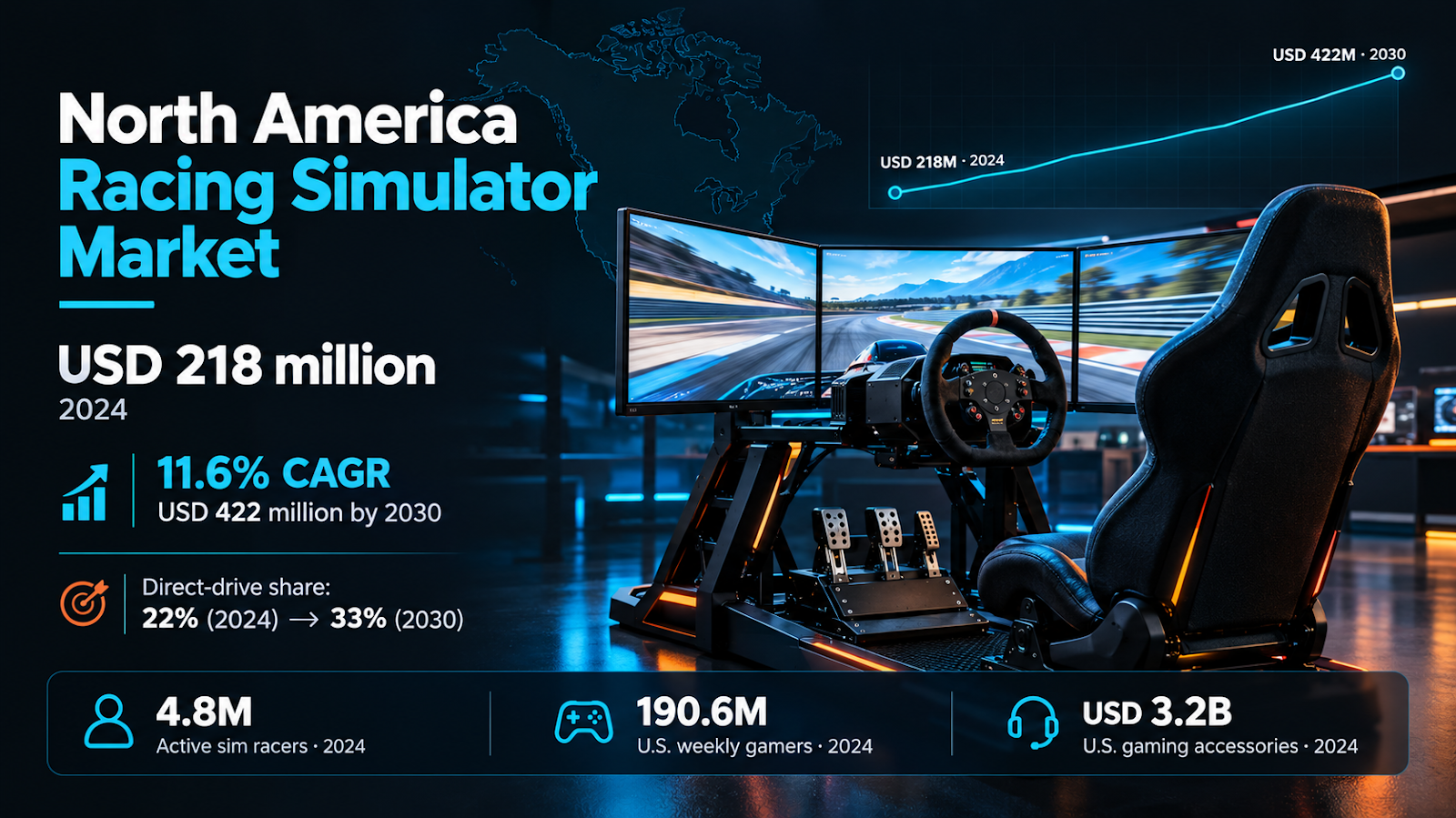
The North America Racing Simulator Market is entering a more commercially diversified phase as premium hardware, recurring software revenue and professional simulator installations reshape spending. According to proprietary estimates from Ken Research, the market was valued at USD 218 million in 2024 and is forecast to reach approximately USD 422 million by 2030, representing an 11.6% CAGR. The important shift is from individual equipment purchases toward sustained customer monetization through compatible hardware upgrades and digital services.
Racing simulators generate revenue through steering wheels, wheelbases, pedals, cockpits, software subscriptions and commercial simulation experiences, with hardware remaining the largest revenue pool. The opportunity is expanding as enthusiasts upgrade from entry-level equipment to premium direct-drive systems, although import dependence and compatibility problems threaten margins. The adjacent Global Gaming Peripherals Market provides broader context for how specialized gaming accessories benefit from immersive experiences and higher-value device purchases. Sustainable growth will depend on capturing more spending per customer rather than relying exclusively on new users.
How Fast Will North America's Racing Simulator Market Grow by 2030?
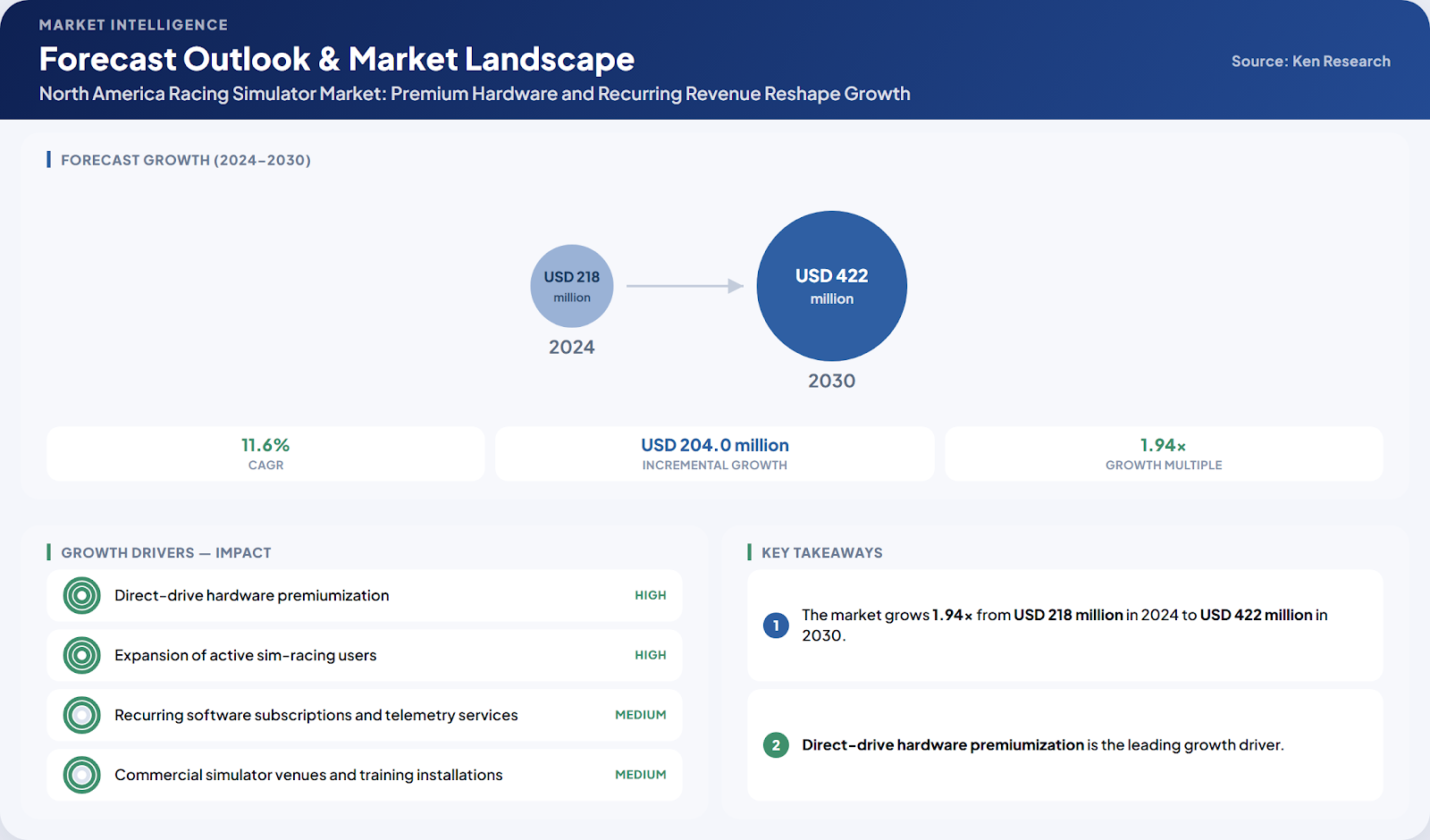
The North America racing simulator market is forecast to nearly double in value between 2024 and 2030, supported by equipment premiumization and an expanding population of active simulation enthusiasts. Ken Research analysis indicates approximately USD 204 million in additional annual market revenue at the forecast endpoint compared with the historical base. This expansion creates opportunities across hardware manufacturing, software publishing, specialist retail and commercial installation services, although growth rates alone do not reveal which activities capture the strongest margins.
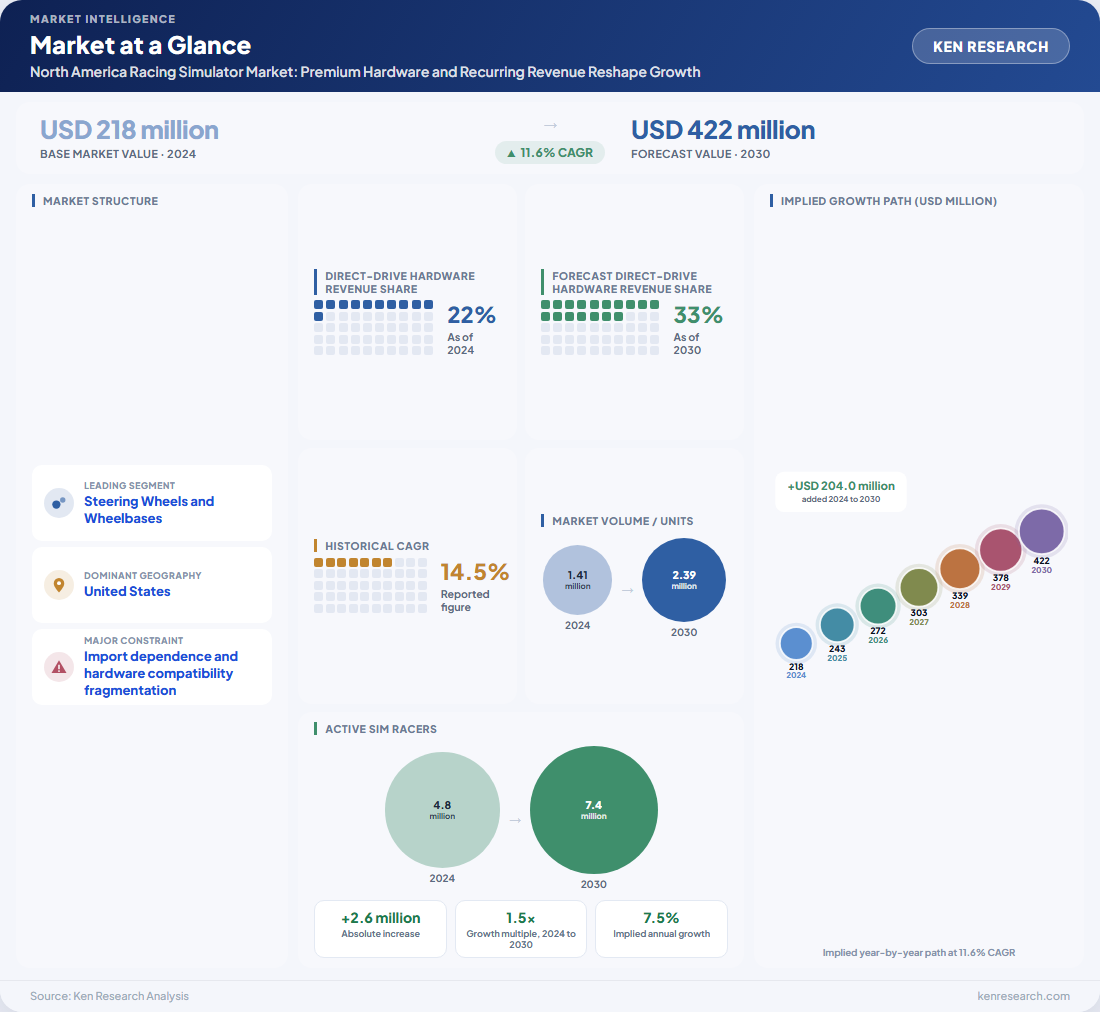
- 14.5% historical CAGR: The market's estimated growth during 2019–2024 benefited from home entertainment adoption and the formation of enthusiast communities, creating an installed base for subsequent upgrades.
- 4.8 million to 7.4 million users: Active North American sim racers are expected to increase between 2024 and 2030, widening the potential audience for accessories and subscriptions.
- 1.41 million to 2.39 million units: Forecast market volume growth points to expanding equipment demand, giving distributors a larger base for cross-selling compatible products.
- Global gaming exposure: The Global Gaming Market offers useful context for the PC and console ecosystems from which specialist racing-simulation customers emerge.
The commercial distinction is that participant growth creates the initial sales opportunity, while product upgrades determine how much value suppliers capture afterward. A larger enthusiast population supports recurring purchases, but hardware vendors must offer meaningful performance improvements to maintain replacement demand. Software developers benefit when frequent racing sessions increase willingness to pay for competitive features and ongoing services. Consequently, the most valuable part of the growth forecast is the change in customer spending behavior, not simply additional simulator ownership.
North America's Sim-Racing Value Chain Rewards Modular Hardware Ecosystems
The North American sim-racing value chain earns revenue through initial device sales, modular equipment upgrades, software subscriptions and commercial simulator services. Steering wheels and wheelbases form the leading product category, while premium pedals, shifters and rigid cockpits extend customer spending beyond the first purchase. Ken Research analysis identifies an important commercial mechanism: compatible accessories allow suppliers to monetize existing customers repeatedly without requiring an entirely new simulator installation. This supports ecosystem loyalty and gives manufacturers opportunities to improve revenue per active customer.
Digital distribution and specialist retail contribute different types of value to that ecosystem. Online channels expand product availability and facilitate comparison shopping, while specialist stores can support demonstrations, installation advice and more complex premium purchases. The U.S. Census Bureau reported that e-commerce represented 17.1% of seasonally adjusted U.S. retail sales during the second quarter of 2026. Although this figure covers retail generally rather than racing simulators specifically, it illustrates the importance of digital purchasing infrastructure for equipment suppliers.
- Hardware first: Wheels, pedals and cockpits create the initial customer relationship, making compatibility and product reliability central to subsequent purchasing decisions.
- Recurring software revenue: Subscriptions, downloadable content and telemetry services can reduce dependence on irregular hardware replacement cycles.
- Commercial installation economics: Simulator venues and training facilities offer additional revenue through equipment integration, maintenance and recurring content requirements.
Why Is Direct-Drive Pricing Changing Racing Simulator Profitability?
Direct-drive technology is changing North American racing simulator economics by bringing stronger force-feedback performance into more accessible product tiers while preserving premium upgrade opportunities. Ken Research estimates that direct-drive systems represented 22.0% of hardware revenue in 2024, with the share forecast to reach 33.0% by 2030. That implies an 11-percentage-point shift toward higher-specification systems, although it does not establish an equivalent increase in manufacturer profit margins. The commercial advantage depends on selling complete, compatible equipment ecosystems rather than isolated components.
- USD 349.99: The Logitech RS50 direct-drive base illustrates an accessible premium entry point that can attract customers moving beyond conventional racing wheels.
- USD 659.99: Fanatec's reported entry-ready direct-drive bundle demonstrates another price tier for enthusiasts seeking a more complete performance upgrade.
- Above USD 2,500: Higher-end Fanatec bundles illustrate the premium spending ceiling available to specialist suppliers serving committed enthusiasts.
- 11 percentage points: The projected direct-drive revenue-share increase creates a product-mix opportunity, provided premium pricing does not suppress conversion.
Pricing power also depends on manufacturing costs, freight expenses, inventory management and distributor margins. The U.S. Bureau of Labor Statistics reported that import prices for computer and electronic product manufacturing declined 1.0% during 2025, although this broader index is not a racing-simulator cost measure. For equipment manufacturers, the relevant profitability test is whether premium product mix outweighs hardware procurement, support and distribution expenses. This becomes particularly important when comparing residential buyers with commercial installations.
How Do Residential and Commercial Sim-Racing Economics Differ in North America?
Residential and commercial racing simulator buyers in North America generate different revenue patterns because households primarily purchase equipment for personal use, while commercial customers monetize simulator availability and utilization. Residential demand favors modular upgrades and repeat accessories, whereas training centers and entertainment venues require integrated systems, installation support and dependable operation. The Global Online Simulation Games Market provides adjacent context for interactive simulation content and the engagement that sustains hardware usage. These differences make customer lifetime value more informative than equipment sales alone.
Commercial venues face a different investment calculation from home users because each installed simulator must generate sufficient revenue to cover equipment depreciation, software licensing, maintenance and operating expenses. Professional training environments also prioritize repeatability, interoperability and technical support over consumer entertainment features. The related USA Esports Market illustrates the broader commercial role of organized gaming events, sponsorships and audience monetization. For simulator operators, however, dependable capacity utilization remains the essential condition for converting customer engagement into operating returns.
Don’t miss the next North America's racing simulators move beyond hardware sales: shift. Ken Research continuously publishes new market intelligence, forecasts and industry analysis. Add Ken Research as a Preferred Source on Google to discover more of our research when your next market question comes up.
Import Dependence and Compatibility Threaten North American Sim-Racing Margins
Import dependence creates a material operating risk for North American racing simulator suppliers because many wheels, pedals and cockpit components are manufactured in Asia before reaching regional distributors. Southern California is consequently important for inbound inventory and fulfillment. The government-operated Port of Los Angeles handled approximately 10.3 million TEUs during 2024, illustrating the scale of this logistics gateway. This throughput is not simulator-specific, but the corridor's infrastructure matters for procurement lead times, inventory availability and landed costs.
Technology fragmentation adds another layer of pressure as games, consoles, personal computers and specialist equipment do not always support identical configurations. Retailers and commercial integrators may consequently face higher testing, returns, technical support and maintenance costs. Ken Research analysis suggests a useful risk framework: suppliers should assess landed equipment cost, software compatibility and service burden together when evaluating product profitability. A competitive price is insufficient if installation failures or inventory interruptions erode customer lifetime value.
- Import exposure: Suppliers should track freight costs, customs treatment and inventory concentration because disruptions can reduce product availability during important sales periods.
- Compatibility performance: Hardware brands should monitor supported games, platforms and accessories to reduce returns and preserve upgrade opportunities.
- Utilization economics: Commercial venue operators should measure paid simulator hours against available hours before expanding equipment fleets.
Where Should Racing Simulator Investors Focus Through 2030?
North America's racing simulator market is moving toward a more valuable combination of premium equipment, recurring software and commercial simulation services rather than depending solely on first-time hardware purchases. The forecast expansion toward approximately USD 422 million by 2030 makes modular direct-drive systems, software integration and reliable commercial installations attractive areas for evaluation. Investors and suppliers should prioritize customer retention, compatible upgrade paths and disciplined inventory management, while monitoring affordability, import costs and technology fragmentation as possible constraints on forecast realization.
Explore the North America Racing Simulator Market report for detailed market segmentation, competitive benchmarking, revenue opportunities and forecast assumptions. The research supports investment screening, procurement planning and product portfolio decisions across hardware, software and commercial simulation applications.


Comments
Post a Comment