South Africa Real Estate Digital Platforms Market Shifts From Listings to Recurring Revenue

South Africa's Property Platforms Are Moving Beyond Listings: Ken Research Examines Where Recurring Revenue Can Emerge
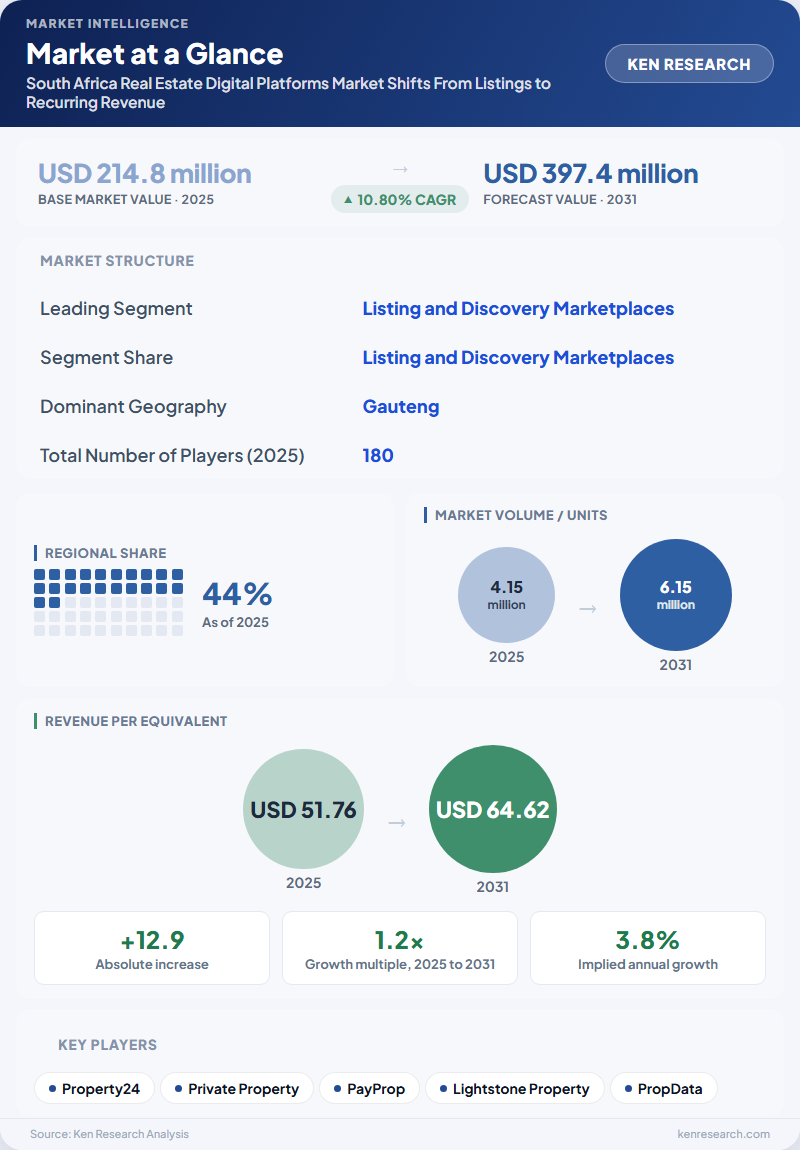
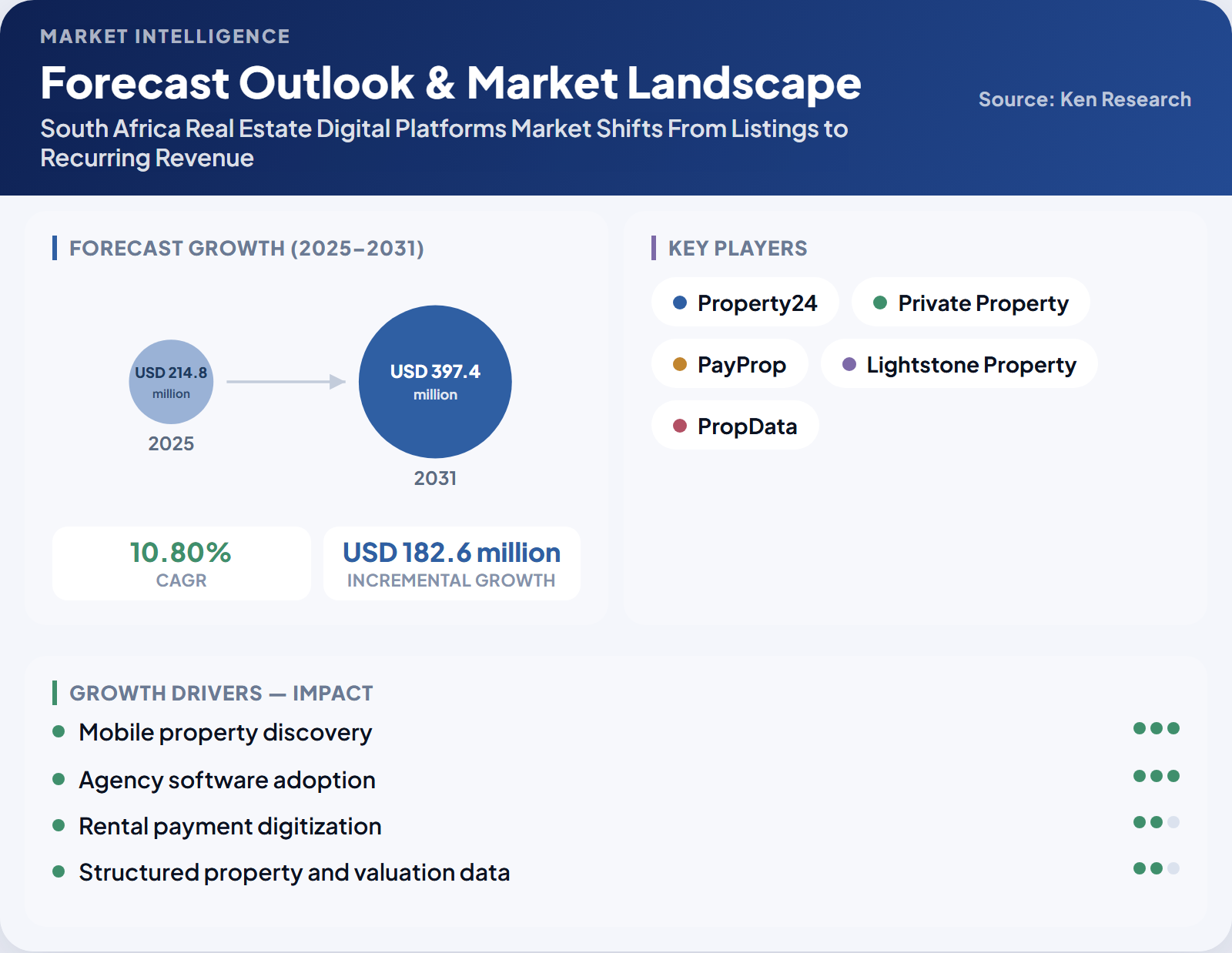
South Africa's real estate digital platforms market is developing from online property discovery into a broader commercial ecosystem connecting buyers, sellers, landlords, estate agents, property managers and financial-service providers. According to Ken Research, the market was valued at USD 214.8 million in 2025 and is projected to reach USD 397.4 million by 2031, representing a CAGR of 10.80%. The opportunity extends beyond listing advertisements into software, data, rental payments and transaction-related services.
The central commercial shift is from monetizing property visibility to earning revenue throughout the property lifecycle. Better integration between discovery, rental administration, valuation information and transaction workflows could create repeat business rather than relying exclusively on advertising and agent subscriptions. The broader South Africa real estate and smart housing market provides useful context for the wider technology opportunity. However, fragmented systems, uneven purchasing power, privacy obligations and the cost of converting users into paying customers could limit how much of the forecast growth becomes profitable.
How Big Is South Africa's Digital Property Platform Market by 2031?
South Africa's real estate digital platforms market is forecast to expand substantially by 2031, with the projected revenue increase reflecting both a larger monetized service base and higher revenue per service equivalent. The published market estimate covers property listings, advertising, professional portal packages, property-management software, rental payment services, deeds and valuation data, mortgage and conveyancing referrals, digital transaction workflows and property investment platforms. It excludes total property transaction values and offline estate-agent commissions, keeping the estimate focused on digital platform revenue.
- USD 182.6 million in additional annual market value: Ken Research analysis calculates the difference between the 2025 base and the 2031 forecast. Providers need to build monetizable services rather than assume that increased browsing alone will generate this increment.
- 6.78% volume CAGR: Monetized platform service equivalents are forecast to increase from 4.15 million in 2025 to 6.15 million in 2031. This indicates that service adoption is a material growth mechanism, alongside changes in monetization.
- 10.80% revenue CAGR: The projected market expansion exceeds the forecast growth in service-equivalent volume, making pricing, premium product adoption and recurring service revenue important variables to monitor.
The key analytical distinction is between growth in platform usage and growth in monetization. Ken Research's forecast implies that providers must capture more value from their service relationships, not simply attract more visitors. The next question is which parts of the property value chain can sustain that additional revenue.
Where Does South Africa's Property Technology Value Chain Earn Its Margin?
South Africa's digital property value chain offers several potential revenue layers, from advertising and listing subscriptions to property-management tools, payment administration, valuation data and digital referrals. Listing and discovery marketplaces represent the largest identified segment. Their commercial advantage comes from aggregating property supply and buyer attention, while specialized service providers can monetize operational workflows that customers use repeatedly.
The strongest strategic opportunity is to use a discovery relationship as an entry point into higher-frequency services. For example, property managers may value rental administration and reporting beyond the initial tenant search, while agents may pay for structured property data and tools that improve lead handling. The adjacent South Africa real estate and PropTech services market provides a broader context for technology-enabled property services, although its overall market scope should not be confused with digital-platform revenue alone.
Three revenue pools worth separating
- Listing and discovery: Paid visibility, advertising and professional subscriptions monetize access to relevant property-seeker audiences, but returns depend on listing quality and qualified lead conversion.
- Workflow and rental services: Property-management software and rental payment functionality can support recurring relationships, provided the tools reduce administrative effort and integrate into customers' existing processes.
- Data and referrals: Valuation information and transaction-related referrals create additional monetization opportunities when information is reliable, relevant and valuable enough to justify a fee.
These revenue pools have different economics: marketplace products depend on audience liquidity, whereas software and data products depend more on retention, usefulness and workflow integration. A provider's strategic priority should therefore be to identify which paid service solves a recurring customer problem, rather than treating every additional feature as an independent revenue opportunity.
Why Are Mobile Discovery and Integrated Workflows Changing Adoption Economics?
Mobile internet access broadens the addressable audience for digital property services, while the ability to connect discovery with downstream administration creates an opportunity to monetize users more than once. Statistics South Africa's General Household Survey, reported by the government in May 2025, found that 85.6% of households had internet access through any means in 2025, while 20.6% had fixed internet access at home. These are national connectivity indicators, not direct measures of property-platform adoption.
The commercial implication is that platforms must support mobile-first journeys without assuming that every customer has the same connectivity, purchasing power or digital confidence. Integrating discovery with payments and property administration may strengthen customer retention, but the business case depends on whether the integration reduces friction enough to justify its implementation and support costs. Broader digital financial infrastructure, including the South Africa digital payments market, offers relevant context for the payment layer without proving that property-specific payment adoption will follow the same trajectory.
- Mobile accessibility: A simple search and enquiry journey can widen reach, but slow pages, difficult forms and weak listing information can reduce qualified leads.
- Workflow integration: Connecting rental administration and property data can create repeat usage, provided customers do not need to maintain duplicate records across systems.
- Payment functionality: Digital payment services can reduce manual administration, but providers must account for transaction reliability, customer support and relevant compliance obligations.
- Data quality: Accurate listings and credible property information can strengthen conversion and trust, while inconsistent or outdated records undermine the value of the platform.
South Africa's official household connectivity findings support the case for digital reach, but connectivity is only the first step. Sustainable monetization also requires relevant inventory, dependable information and services that solve problems beyond initial discovery.
How Do Listing Marketplaces and Specialized Platforms Differ Commercially?
South Africa's property platforms compete through different combinations of audience reach, professional relationships, data depth and operational functionality. Ken Research identifies Property24, Private Property, PayProp, Lightstone Property and PropData among the market's major participants, but the available published summary does not establish a verified revenue-share ranking for these businesses. The relevant commercial question is which customer problem each provider serves and whether its product creates a durable reason to keep paying.
Listing marketplaces can benefit from network effects when more relevant listings attract more property seekers and stronger buyer activity encourages agents to participate. Specialized rental, property-data and professional software providers can compete through accuracy, workflow fit and operational usefulness rather than audience scale alone. The adjacent South Africa facility management in real estate market illustrates a related operational-services layer, where digital tools can support property operations but do not replace the underlying service delivery requirements.
For buyers, the appropriate comparison is total workflow value rather than feature count alone. For providers, defensibility is more likely to come from trusted data, repeat customer use, integration depth and service reliability than from expanding the number of listings without improving their commercial quality.
Don’t miss the next examines where recurring revenue can emerge shift. Ken Research continuously publishes new market intelligence, forecasts and industry analysis. Add Ken Research as a Preferred Source on Google to discover more of our research when your next market question comes up.
What Could Weaken Digital Property Platform Unit Economics?
South Africa's real estate digital platforms market faces a central execution risk: additional digital activity does not automatically translate into profitable revenue. Customer acquisition, data maintenance, software development, cybersecurity, integration and support all consume resources, while agents and landlords may resist paying for tools that duplicate existing systems or produce insufficient incremental value. Providers must demonstrate that their products improve measurable outcomes, such as qualified enquiries, administrative efficiency or customer retention. The Protection of Personal Information Act 4 of 2013 is also relevant when platforms collect and process personal information, making privacy controls an important operational consideration.
Digital transactions also require appropriate attention to legal compliance, data handling and customer trust. The government's Electronic Communications and Transactions Act 25 of 2002 establishes a legal framework for electronic communications and transactions, but it should not be treated as a substitute for reviewing all applicable property, consumer-protection and privacy requirements. Providers expanding into payments, referrals or transaction workflows must assess the specific obligations relevant to each service.
- Acquisition costs: Monitor the cost of converting visitors into paying agents, landlords and professional users, rather than relying on traffic growth alone.
- Retention and churn: Track renewal behaviour and continued workflow usage to test whether subscriptions deliver sustained value.
- Data and integration costs: Assess the resources required to maintain accurate listings, connect third-party systems and resolve operational failures.
- Trust and compliance: Review data quality, privacy controls, payment reliability and customer complaints as potential sources of cost and reputational damage.
The counter-thesis is that the market can expand without every platform becoming more profitable. If customers resist higher prices or the cost of delivering integrated services rises faster than revenue per customer, market growth may coexist with margin pressure. That makes disciplined unit-economics measurement as important as forecasting headline revenue.
Where Will South Africa's Digital Property Platform Opportunity Deliver Value by 2031?
South Africa's real estate digital platforms market offers its strongest strategic case where property discovery connects naturally to recurring professional services, rental workflows and reliable data. Ken Research's forecast points toward a larger revenue pool, but the commercial outcome will depend on adoption, pricing power and the ability to convert technology investments into customer value. Providers should prioritize products with clear operational benefits, measurable retention and a credible path to recovering implementation and support costs.
For investors, property businesses and technology providers assessing entry, expansion or product strategy, the decision is not simply whether the market will grow, but which revenue models can capture that growth sustainably. Explore the South Africa Real Estate Digital Platforms Market report from Ken Research for the detailed market estimates, segmentation, competitive assessment and forecast framework needed to evaluate the opportunity.


Comments
Post a Comment