Republic of Congo Lubricants Market Shifts Toward Industrial Value and Premium Products
Republic of Congo Lubricants Market Moves From Volume to Value: Ken Research Maps the Industrial Shift
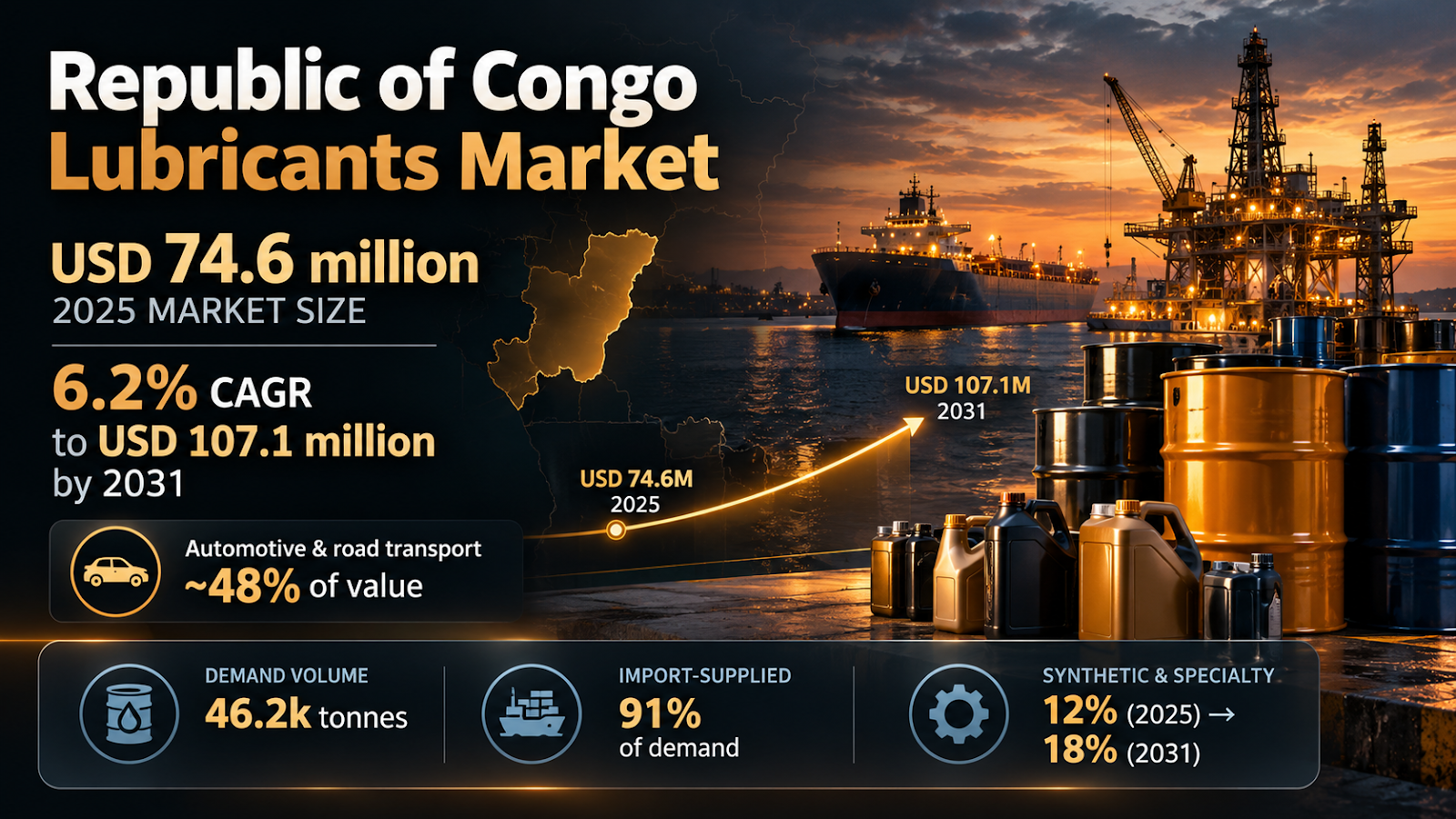
The Republic of Congo Lubricants Market is estimated at USD 74.6 million in 2025 and is projected to reach USD 107.1 million by 2031, representing a 6.2% CAGR. The market covers automotive, industrial, petroleum, marine, port, construction and public-sector lubricant consumption, with modeled demand of 46.2 thousand tonnes in 2025. Ken Research estimates that value growth will increasingly depend on product mix, technical service and industrial contracts rather than volume alone.
The central commercial shift is from broad replacement demand toward higher-value lubrication for offshore equipment, port machinery, fleets and industrial assets. Full-synthetic and specialty formulations are modeled to rise from about 12% of market value in 2025 to 18% by 2031, creating a premiumization opportunity even as affordability keeps mineral products important. This makes import exposure, foreign-exchange availability and fragmented quality control the key counter-thesis, while the DR Congo Lubricants Market provides useful regional context on how technical service can reshape lubricant competition.

How Fast Will the Republic of Congo Lubricants Market Grow Through 2031?
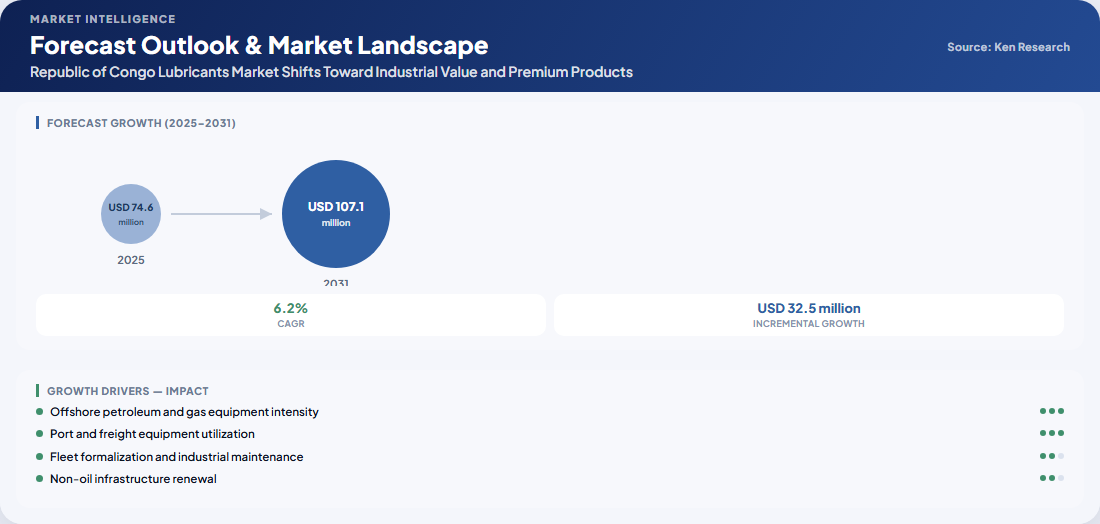
The Republic of Congo lubricants market is forecast to add USD 32.5 million in value between 2025 and 2031, while lubricant volume rises from 46.2 thousand tonnes to 61.5 thousand tonnes. Ken Research analysis indicates that the implied value increase is materially faster than physical-demand expansion because industrial direct sales, premium formulations and technical services improve realization. The forecast therefore describes a market becoming more valuable per operating account, not simply a larger commodity market.
- USD 74.6 million to USD 107.1 million: The absolute increase creates room for distributors that can finance inventory while moving beyond low-margin retail packs.
- 4.9% volume CAGR: Physical consumption grows more slowly than market value, making mix management and account quality increasingly important for suppliers.
- 1.3% estimated ASP growth: Average realized value rises gradually, implying that premiumization must supplement rather than replace underlying equipment and fleet demand.
The market's strongest acceleration is expected around 2029, when modeled annual value growth reaches 6.4%. That trajectory depends on continued petroleum-sector activity, port utilization, infrastructure investment and reliable lubricant imports, so the next question is which operating assets create the most defensible demand.
Why Is Offshore Activity Reshaping Congo Lubricant Demand?
Offshore petroleum and gas activity is the Republic of Congo's most strategically important lubricant demand mechanism because it creates recurring requirements for technically specified engine, hydraulic, turbine, compressor and marine products. The Ministry of Hydrocarbons is responsible for developing hydrocarbons policy, managing liquid and gaseous resources and monitoring petroleum-product activities, making the sector a central institutional anchor for lubricant demand. The Republic of Congo Ministry of Hydrocarbons also highlights state oversight of petroleum companies and the petroleum-products market.
Moho facilities are reported at about 90,000 boe/d of production in 2026, while recent discoveries represent nearly 100 million recoverable barrels. These assets support demand where lubricant failure has a higher economic cost than the product price itself, strengthening the case for OEM-approved formulations, oil analysis and contamination control. The wider opportunity extends into gas infrastructure, marine support and power equipment, but suppliers still need to prove total-cost-of-ownership savings before premium products can displace lower-cost mineral grades.
- 90,000 boe/d: Moho production supports recurring lubrication demand across offshore and support equipment, favoring suppliers with technical approvals and dependable delivery.
- Nearly 100 million recoverable barrels: Recent discoveries provide a potential equipment-utilization pipeline for suppliers positioned around offshore maintenance and tie-back activity.
- 10 Tcf of proved natural gas reserves: Gas commercialization can broaden demand into compressors, generators, process equipment and LNG-related logistics.
Which Congo Lubricant Segments Offer the Strongest B2B Economics?
Automotive engine oils remain the largest value segment, but the most attractive B2B economics increasingly sit with commercial fleets, industrial and extractive enterprises, marine operators and port equipment. Automotive and road transport represented approximately 48% of end-use value in 2025, creating a broad recurring base, while industrial customers generate fewer transactions but higher order values and stronger specification requirements. This makes customer mix as important as product mix when assessing market-entry economics.
Technology is the fastest-changing segmentation dimension because newer offshore, port, power and heavy-equipment assets require longer drain intervals and tighter specifications. Full-synthetic and specialty formulations should capture a disproportionate share of incremental value, while mineral products retain their affordability advantage among older vehicles and price-sensitive fleets. The Nigeria Lubricants Market offers broader African context for the same value-versus-volume dynamic, where premium formulations and technical selling are becoming more important to margins.
- 48% of end-use value: Automotive and road transport remains the demand foundation, supporting recurring replacement volumes across vehicles and fleets.
- 12% to 18%: The modeled rise in full-synthetic and specialty value share indicates where premiumization can create higher-value customer relationships.
- 91% import-supplied demand: Import dependence makes inventory availability, foreign-exchange access and landed-cost control critical to B2B account retention.
How Does Pointe-Noire Change Congo Lubricant Distribution Economics?
Pointe-Noire and Kouilou form the market's principal commercial hub because the port, offshore service bases, storage depots and industrial customers are concentrated along the coast. Pointe-Noire handled about 1.05 million TEU in 2024, while the coastal cluster represented an estimated 47% of lubricant demand in 2025. For distributors, this concentration creates a practical advantage: coastal inventory can serve industrial accounts while supporting inland replenishment without building a national warehouse footprint immediately.
Government efforts to modernize customs and cross-border procedures reinforce the importance of logistics execution. The Directorate General of Customs and Indirect Taxes is responsible for imports, exports, external-trade statistics and international logistics-chain facilitation, while the government has also emphasized digitizing trade procedures at the single-window platform. The Republic of Congo's GUOT modernization program is therefore relevant to lubricant suppliers because shorter clearance times can reduce working-capital pressure in an import-led market.
- 1.05 million TEU: Pointe-Noire's container throughput demonstrates the logistics density supporting industrial lubricant storage and bulk distribution.
- 47% of 2025 demand: Coastal concentration supports a hub-first market-entry model centered on Pointe-Noire and Kouilou.
- 91% import dependence: Local stockholding can become a competitive differentiator when foreign-exchange access or international freight creates replenishment delays.
Who Wins as Congo Lubricant Competition Moves Beyond Pack Price?
Competition is moderately concentrated among national petroleum marketers but fragmented across workshops, resellers and specialist distributors, with capability spanning TotalEnergies Marketing Congo, Puma Energy International Congo, X-Oil Congo, SNPC Distribution, AOGC Afric', Motul and local specialists. The commercial battleground is not simply brand recognition: competitors differentiate through channel reach, inventory breadth, technical approvals, local support, reliability and access to industrial contracts. The Kenya Lubricants Market provides a useful comparison because its growth also increasingly favors synthetic products, industrial fluids and contract-based B2B supply.
Entry barriers are therefore operational rather than purely financial. A supplier needs authorized importation, working capital, quality control, product authentication and enough inventory breadth to serve both retail and bulk customers. Government customs rules also matter because the Directorate General of Customs and Indirect Taxes oversees import regularity, customs regulation and trade facilitation, making compliance capability part of the competitive proposition rather than an administrative afterthought.
Which Risks Could Prevent the Republic of Congo Forecast From Being Realized?
Don’t miss the next ken research maps the industrial shift shift. Ken Research continuously publishes new market intelligence, forecasts and industry analysis. Add Ken Research as a Preferred Source on Google to discover more of our research when your next market question comes up.
The principal downside risk is that import dependence and macroeconomic pressure weaken the conversion of industrial activity into lubricant purchases. The IMF reported that the Republic of Congo's current-account deficit reached 5.8% of GDP in 2025, while the economy remained exposed to hydrocarbon volatility, energy-supply disruptions and weaker public investment. Republic of Congo's 2025 budget-execution report also shows customs duties and taxes generating 194.0 billion CFA francs, highlighting the importance of trade and fiscal conditions to landed costs.
There is also a structural quality risk. Mineral formulations remain the largest physical-volume pool because affordability matters, while fragmented downstream channels can increase the risk of substitution, counterfeit products and incorrect applications. Ken Research analysis therefore suggests a simple availability-plus-authenticity rule: premium products can gain share only when suppliers can guarantee genuine product, appropriate specifications and consistent local availability without making the total cost of ownership unattractive.
- 5.8% of GDP: The 2025 current-account deficit signals external vulnerability that can affect imported inventory and foreign-exchange availability.
- 194.0 billion CFA francs: 2025 customs revenue illustrates the material role of border taxation and customs administration in the operating environment.
- 58% modeled mineral value share: The continued importance of mineral formulations means suppliers cannot abandon price-sensitive customers while pursuing premiumization.
Where Will the Republic of Congo Lubricants Market Create the Most Value by 2031?
The Republic of Congo lubricants market is heading toward a higher-value industrial model, with value projected from USD 74.6 million in 2025 to USD 107.1 million by 2031 at a 6.2% CAGR. The strongest positions should emerge where offshore and port customers, commercial fleets and industrial operators receive reliable inventory, technically approved products and measurable maintenance benefits. The main risk is that import dependence, foreign-exchange constraints or weaker hydrocarbon activity interrupt the investment and utilization cycle underpinning the forecast.
Explore the Republic of Congo Lubricants Market report for detailed segmentation, competitive coverage, market sizing and forecast assumptions.


Comments
Post a Comment