Poland Telecom Towers & 5G Infrastructure Market Shifts Toward Higher Revenue per Site
Poland’s 5G Infrastructure Is Becoming a Revenue-Density Business, Not Just a Tower-Building Cycle: Ken Research Examines the Investment Shift
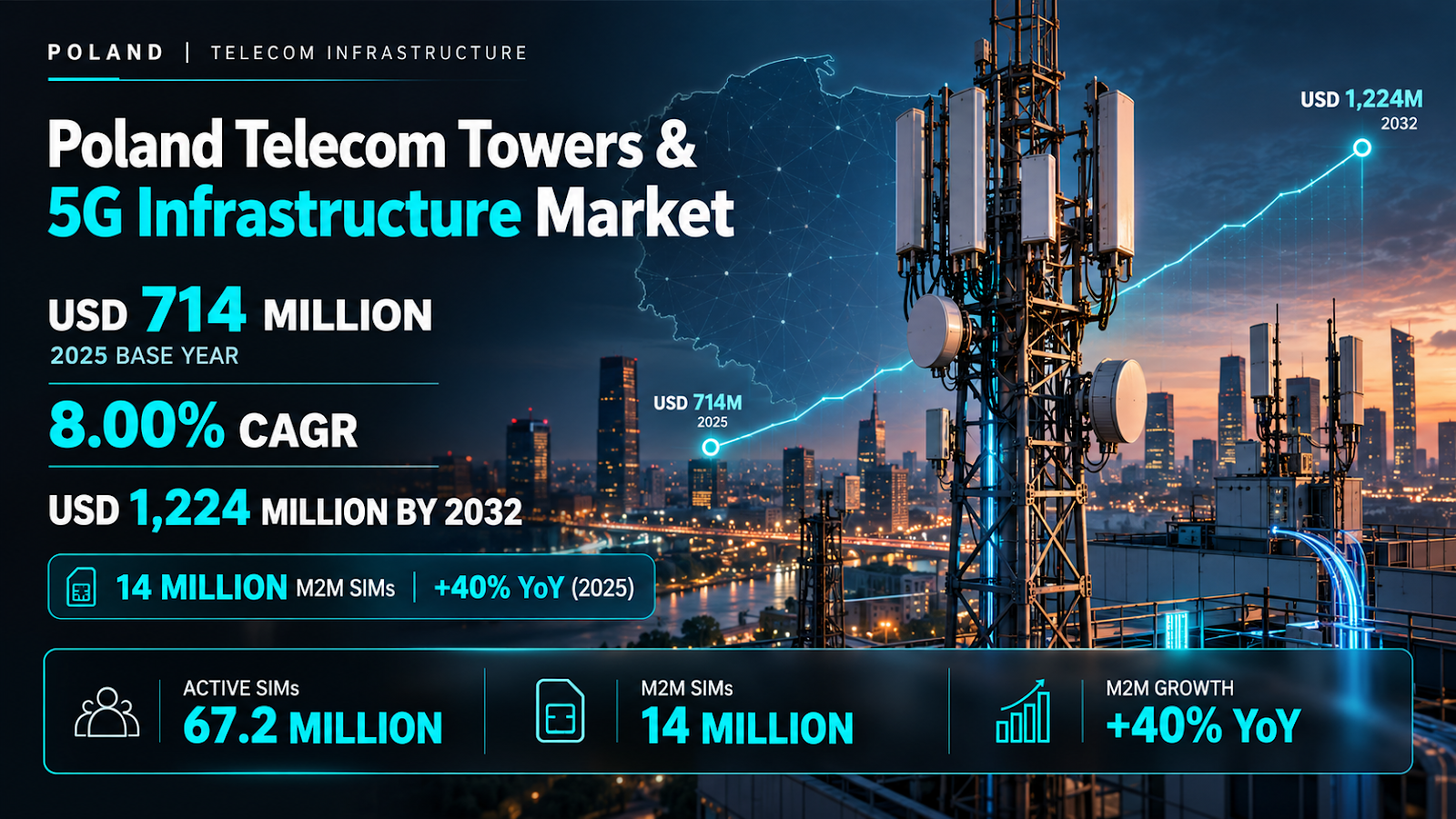
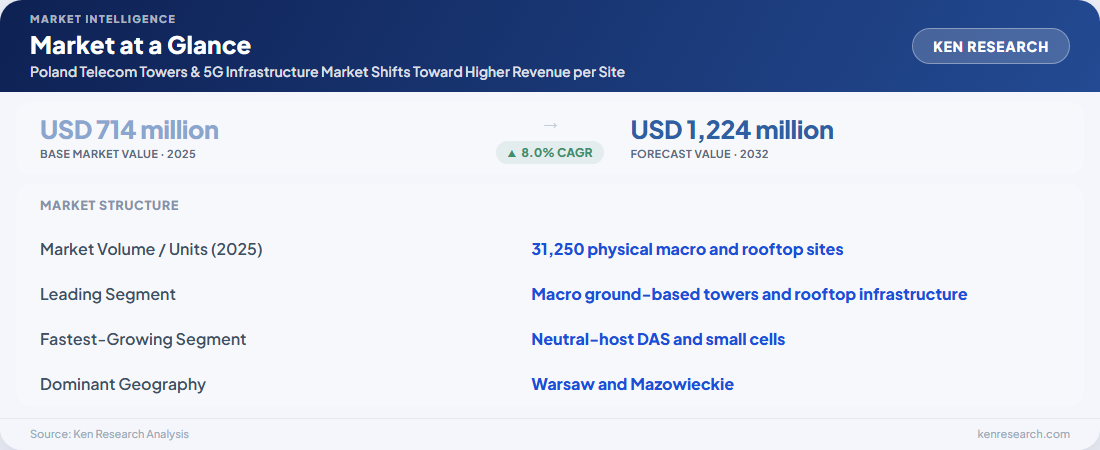
Poland’s telecom towers and 5G infrastructure market is moving from ownership consolidation toward higher-value infrastructure monetization. Ken Research estimates the market at USD 714 million in 2025, with a forecast of USD 1,224 million by 2032, representing a compound annual growth rate (CAGR) of 8.0%. The August 2026 market assessment points to a commercial shift: infrastructure owners can increase revenue by accommodating more tenants, supporting additional radio layers and bundling backhaul services, rather than relying exclusively on new tower construction. The analysis is published by Ken Research.
The commercial opportunity depends on whether network operators and infrastructure owners can turn connectivity investment into recurring, contract-backed returns. Growing machine-to-machine connectivity, indoor coverage requirements and fibre-linked sites support demand, while extensive network sharing, high capital requirements and weaker rural-site economics constrain returns. The Poland Data Centers & Cloud Infra Market provides a useful adjacent perspective: the value of digital infrastructure increasingly depends on interconnected capacity, not isolated physical assets. The strategic question for investors is therefore which locations and services can sustain attractive utilization as basic coverage becomes more widespread.
How Large Is Poland’s Telecom Towers Market, and What Drives Growth Through 2032?
Poland’s telecom towers and 5G infrastructure market is forecast to expand as revenue per location rises faster than the physical site base. The proprietary Ken Research estimate covers monetized passive tower and rooftop leasing, colocation, managed active radio infrastructure, neutral-host systems and fibre-to-tower or backhaul services. It excludes telecom equipment sales, spectrum licence payments and mobile operators’ retail-service revenue. This distinction matters because infrastructure-service revenue can increase even when the number of new structures grows comparatively slowly.
The historical expansion also requires careful interpretation: the estimated market grew rapidly during 2020–2025, partly because previously captive mobile-network infrastructure was transferred into independent tower businesses and commercialized through external contracts. That acquisition-driven step-change should not be extrapolated indefinitely. For the forecast period, the more useful test is whether tenancy additions, contractual price adjustments and managed services can generate incremental revenue without equivalent increases in site acquisition and construction expenditure.
- USD 510 million of additional annual market value: The difference between the 2025 base and the 2032 forecast is a derived calculation from the proprietary estimates, indicating the scale of commercial expansion available to infrastructure providers.
- 31,250 physical macro and rooftop sites: The estimated 2025 installed base provides the starting point for evaluating colocation, modernization and site-level utilization rather than treating every forecast dollar as new-build demand.
- 3.1% annual physical-site growth: The report’s estimated pace of site expansion is materially below market-value growth, suggesting that investors should prioritize tenancy, service mix and recurring revenue when assessing returns.
Ken Research analysis identifies a useful decision rule: measure infrastructure growth through both physical additions and monetization per site. This separates genuine expansion in recurring service demand from changes driven by asset transfers or accounting boundaries. The next question is which traffic and deployment mechanisms can support that higher revenue density.
Why Is Poland’s 5G Infrastructure Investment Shifting Toward Densification?
Poland’s 5G infrastructure investment is shifting toward densification because broader coverage increasingly leaves capacity, indoor signal quality and reliable backhaul as the more commercially important challenges. The Office of Electronic Communications (UKE) reported that telecommunications operators invested PLN 12.7 billion in 2025, an increase of 32.8% year on year across the wider telecommunications sector. This official figure is not a tower-market revenue estimate, but it demonstrates the scale of investment activity underpinning network modernization and infrastructure demand.
Machine connectivity adds another layer to the investment case. UKE recorded 67.2 million active SIM cards in Poland at the end of 2025, including 14 million machine-to-machine connections, up 40% year on year. Industrial monitoring, connected utilities, logistics and enterprise applications create persistent requirements for reliable connectivity. However, traffic growth does not automatically translate into tower-owner revenue: the commercial outcome depends on whether operators need additional capacity, whether existing sites can accommodate it and whether contracts allocate the resulting value to infrastructure providers.
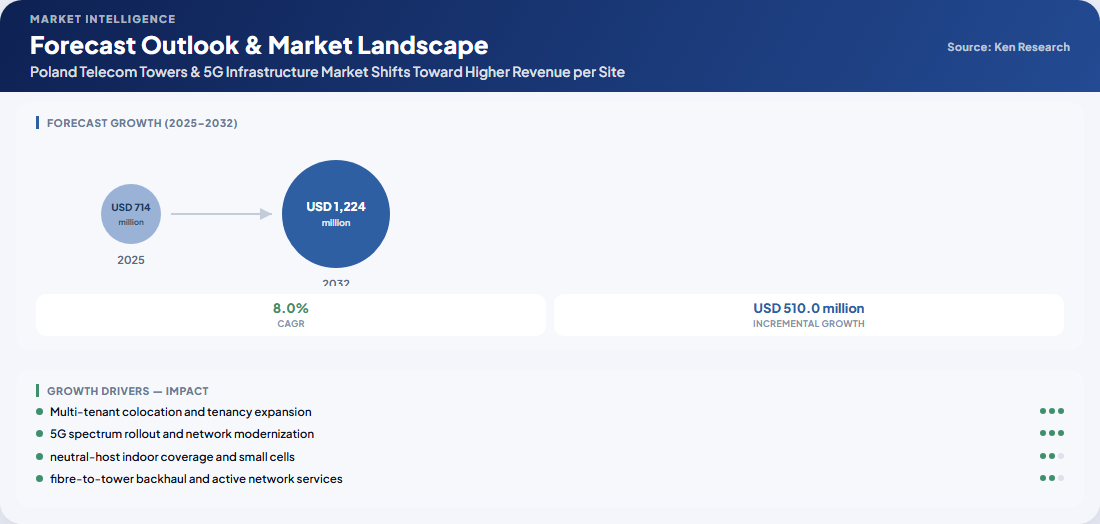
- 14 million M2M connections: The end-2025 installed base strengthens the case for resilient connectivity and backhaul, especially where industrial and logistics applications need dependable network availability.
- 32.8% annual investment growth: UKE’s wider-sector capital expenditure measure signals substantial infrastructure spending, but procurement teams should distinguish addressable tower and backhaul contracts from investment in other network components.
- Indoor and neutral-host deployment: Shared distributed antenna systems (DAS) and small cells can spread infrastructure costs across multiple operators, making dense venues and enterprise campuses potential targets where demand supports utilization.
The adjacent Poland Cloud Computing and SaaS Adoption Market adds context to this demand shift: cloud-based workloads and digital business processes increase reliance on consistent connectivity. Yet tower operators capture that opportunity only when network requirements translate into signed access agreements, incremental tenants or higher-value managed services.
Which Segments and Buyers Matter Most in Poland’s 5G Infrastructure Market?
Mobile network operators remain the core buyers of tower access, colocation and radio-network infrastructure, while enterprise venues, transport facilities and public-sector users create more specialized demand for indoor coverage and reliable connectivity. Macro ground-based towers and rooftop sites form the market’s economic foundation because they support broad geographic coverage and multiple generations of radio equipment. The fastest-growing technology opportunity identified by Ken Research is neutral-host DAS and small cells, where shared deployment can improve the economics of high-density locations.
For procurement teams, the important distinction is between buying physical access and buying a complete connectivity outcome. An infrastructure contract may combine site access, power, structural capacity, radio hosting, fibre connectivity and operational service levels. The best purchasing model depends on traffic density, coverage requirements, deployment timelines and the availability of existing infrastructure. The Poland Smart Manufacturing and Industry 4.0 Market offers adjacent context for industrial connectivity needs, where automation and connected production systems can make reliable network performance operationally important.
- Macro towers and rooftops: These remain the core assets for national coverage and multi-band deployment; buyers should compare lease terms, available structural capacity and the cost of upgrading existing sites against building new ones.
- Neutral-host DAS and small cells: These serve dense indoor and venue environments where macro coverage may be insufficient; commercial viability depends on securing enough operator participation to share deployment and operating costs.
- Fibre-to-tower and managed backhaul: These extend the value proposition beyond physical structures, allowing providers to compete on transmission reliability, service integration and operational support as well as location access.
Ken Research analysis suggests that segment selection should follow a utilization-first test: prioritize assets with credible demand commitments and multiple monetization paths. A technically attractive deployment can still underperform if tenant uptake is delayed or the required backhaul and power upgrades erode contribution margins. That shifts the competitive question from who owns the most sites to who can deliver a dependable, cost-effective service bundle.
Don’t miss the next ken research examines the investment shift shift. Ken Research continuously publishes new market intelligence, forecasts and industry analysis. Add Ken Research as a Preferred Source on Google to discover more of our research when your next market question comes up.
How Do Poland’s Telecom Infrastructure Competitors Win, and What Could Limit Returns?
Poland’s telecom infrastructure competition includes independent tower operators, mobile network groups, shared-radio ventures and wholesale fibre providers. Cellnex Poland Group, Emitel S.A., Orange Polska S.A., NetWorkS! and EXATEL S.A. are identified among the relevant participants, but their roles differ: some monetize physical sites, some share or operate radio access networks, and others supply transmission or wholesale connectivity. These businesses should not be treated as interchangeable competitors, and the available public-facing market summary does not support a reliable, like-for-like ranking of their market shares.
Scale can improve site acquisition, maintenance, financing and multi-tenant utilization, while integrated service portfolios create opportunities to bundle passive infrastructure with active radio services and backhaul. However, network sharing can also reduce demand for duplicate macro locations, while permitting delays and expensive upgrades can weaken project economics. Poland’s official 2026 Digital Decade Country Report identifies persistent regional connectivity disparities and calls for faster 5G deployment in the 3.4–3.8 GHz band and stronger backbone infrastructure. These priorities support investment needs, but do not guarantee commercial returns at every site.
The practical implication is that market entry should focus on defensible niches, such as indoor systems, underserved coverage corridors or fibre-linked sites, rather than undifferentiated greenfield construction. Before committing capital, investors and operators need to test whether expected tenancy, contract duration and incremental service revenue can cover financing, energy, maintenance and upgrade costs. Public coverage targets can improve demand visibility, but commercially sustainable deployment still depends on site-level economics and credible customer commitments.
Which Investment Priorities Will Shape Poland’s Telecom Towers Market Through 2032?
Poland’s telecom towers and 5G infrastructure market is positioned for continued value expansion through 2032, supported by rising revenue per site, network modernization and demand for indoor and fibre-connected capacity. The strongest opportunities are likely to be assets with anchor tenants, credible colocation potential and service bundles that generate recurring revenue. The principal downside is that extensive network sharing, weaker rural utilization and capital-intensive upgrades could prevent infrastructure owners from converting forecast demand into attractive returns. Investment decisions should therefore distinguish coverage obligations from commercially bankable demand.
For investors, infrastructure owners and procurement leaders, the next step is to evaluate asset types, ownership models, technology segments, competitive participants and forecast assumptions together rather than treating the headline growth rate as a standalone investment case. Explore the Poland Telecom Towers and 5G Infrastructure Market report for detailed segmentation, competitive coverage and forecast assumptions.


Comments
Post a Comment