Poland Online Food Delivery Aggregator Market: Growth, Competition and Quick Commerce to 2032
Poland Online Food Delivery Aggregator Market: Growth Will Depend on Quick Commerce, Order Frequency and Profitable Delivery for Ken Research
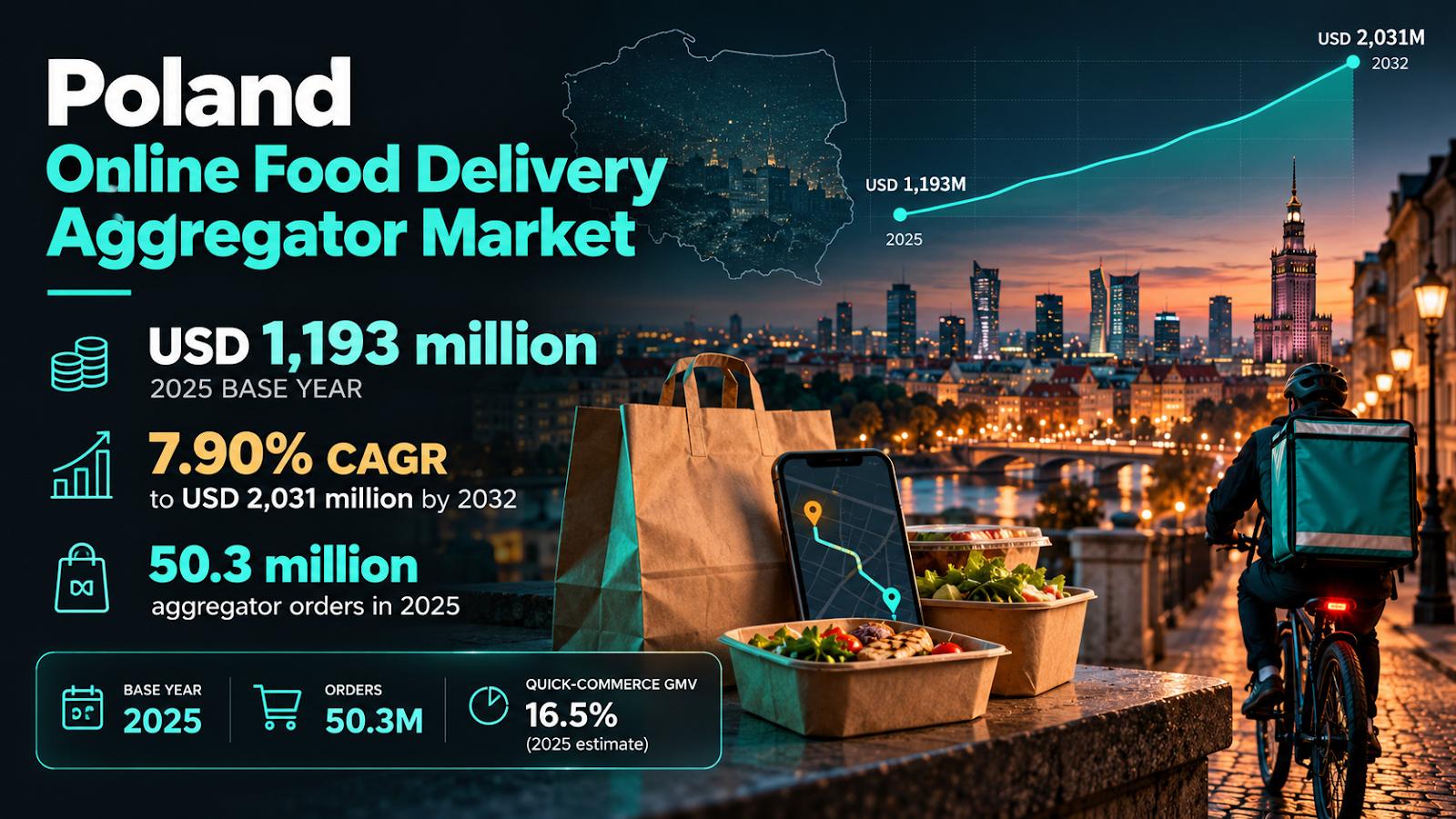
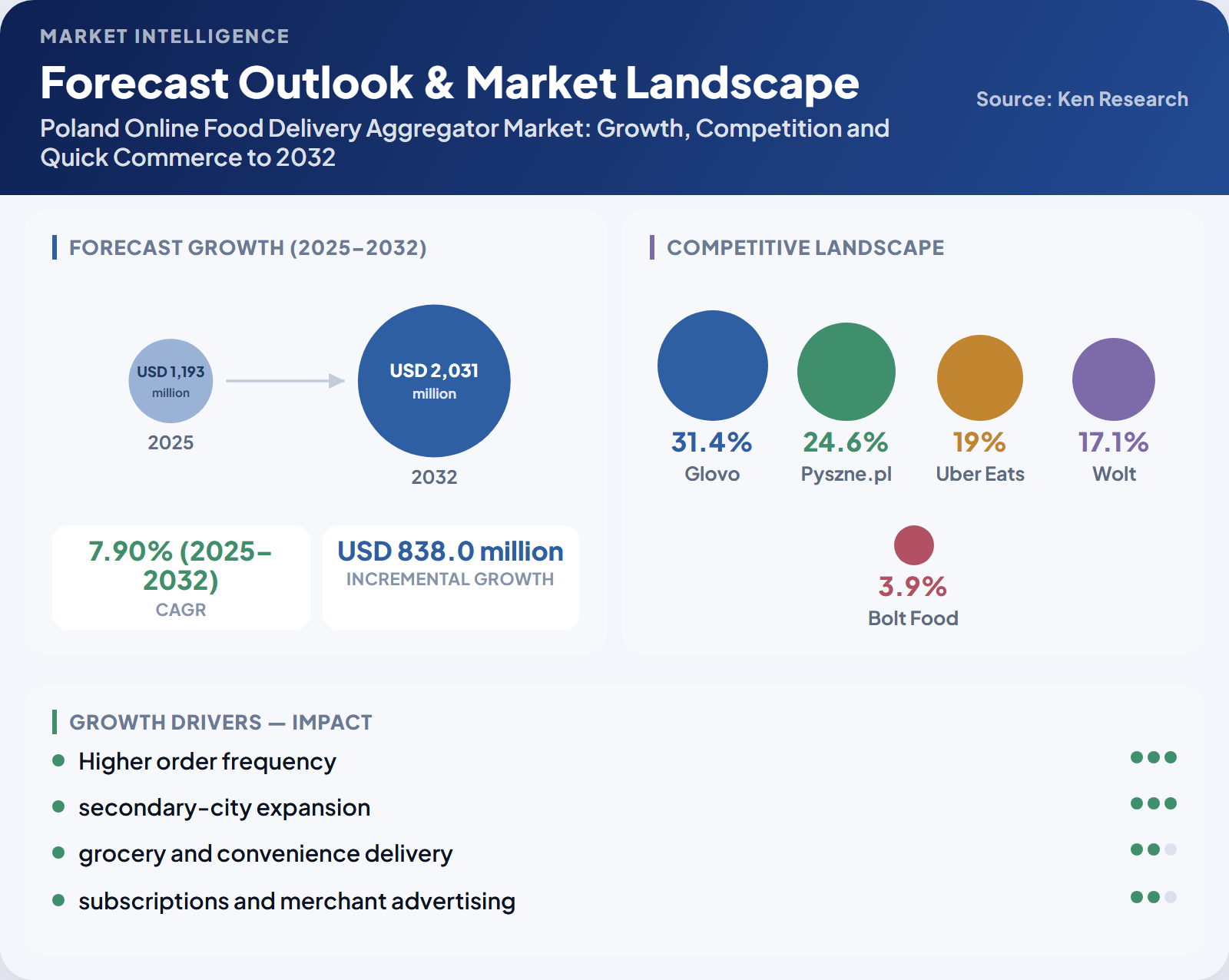
Poland's online food delivery aggregator market is estimated by Ken Research at USD 1,193 million in 2025, with gross merchandise value (GMV) projected to reach USD 2,031 million by 2032, representing a forecast CAGR of 7.90% over 2025–2032. The evidence challenges the assumption that the opportunity is simply about delivering more restaurant meals: growth increasingly depends on grocery convenience, higher-value baskets, recurring orders and more efficient platform economics.
The market connects consumers, restaurants, retailers and couriers through digitally originated orders. For investors and operators assessing adjacent opportunities, Poland's online groceries and quick commerce market provides useful context for understanding how aggregator applications can expand beyond prepared meals into additional shopping occasions.
Myth: Poland's aggregator market is only about restaurant meals, but quick commerce is expanding the opportunity
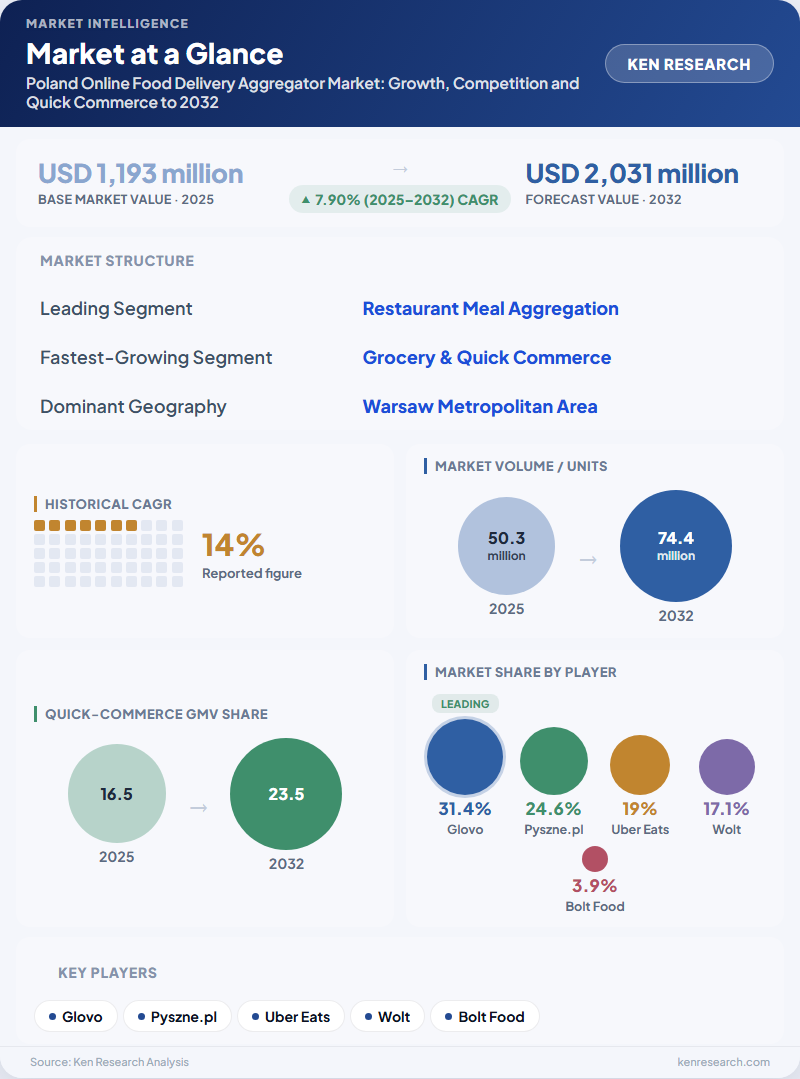
What the evidence shows: Ken Research identifies restaurant meal aggregation as the dominant solution segment, while grocery and quick commerce represent the fastest-growing segment. The market model estimates that grocery and adjacent quick-commerce activity will increase from 16.5% of aggregator GMV in 2025 to 23.5% by 2032. That is an increase of 7 percentage points, indicating that non-meal ordering occasions are becoming more important to the market's growth outlook.
The assumption that restaurant meals will remain central is partly correct. Restaurant transactions provide the merchant density and courier demand that support the existing platform model. However, grocery top-ups and convenience purchases can create additional transactions outside conventional lunch and dinner periods. The related Poland cloud kitchens and food delivery market is another relevant adjacent market because delivery-oriented food preparation and digital ordering share parts of the same demand ecosystem, although the two markets measure different activities.
Analysis: The projected quick-commerce share gain suggests that platforms must increase the number of occasions on which consumers use their applications, rather than relying exclusively on higher restaurant-order frequency. The opportunity depends on local retail availability, fulfilment density, reliable delivery and the economics of smaller baskets. Expanding categories without controlling fulfilment costs could increase order counts without producing equivalent improvements in profitability.
- For investors, evaluate grocery and convenience growth alongside contribution margins, order frequency and fulfilment costs.
- For restaurant partners, assess whether platforms can generate incremental customer demand rather than simply redirecting existing orders.
- For operators, prioritise retail partnerships and delivery zones where repeat orders can support efficient courier utilisation.
Myth: Poland's digital demand has already peaked, but online access and order growth indicate further opportunity
What the evidence shows: Ken Research estimates that aggregator order volume will rise from 50.3 million orders in 2025 to approximately 74.4 million in 2032, equivalent to a volume CAGR of 5.8%. The market's model also estimates historical order growth from 32.0 million in 2020 to the 2025 base. Separately, Statistics Poland reported that 69.7% of people aged 16–74 ordered or purchased goods or services online during the preceding twelve months in 2025, while 96.2% of households had internet access. These official statistics establish a broad digital foundation, but they do not measure food-delivery use specifically.
The distinction between digital access and actual ordering behaviour matters. Consumers can have internet access without ordering meals regularly, and existing customers can increase their order frequency without any increase in internet penetration. The official Statistics Poland information society report supports the digital-access context, while the aggregator forecast measures a narrower commercial activity.
Analysis: The forecast implies approximately 24.1 million additional annual orders between 2025 and 2032. This creates a substantial operational challenge as well as a growth opportunity. More transactions require sufficient courier availability, dependable merchant preparation and delivery capacity in locations where order density supports attractive unit economics.
The geographic opportunity is not evenly distributed. Ken Research identifies the Warsaw Metropolitan Area as the dominant region and highlights Kraków, Wrocław and the Tri-City among important urban markets. The report also points to smaller cities as potential sources of incremental merchant acquisition and order frequency. The commercial case for expansion therefore depends on local density, rather than treating every Polish city as an equally attractive market.
- For expansion teams, compare prospective cities using merchant coverage, order density and courier availability.
- For marketing teams, distinguish customer acquisition from retention and repeat-order growth when measuring performance.
- For investors, test whether forecast order growth can be served without a disproportionate increase in delivery and promotional spending.
Myth: Market leadership guarantees strong margins, but concentration also increases commercial pressure
What the evidence shows: Ken Research estimates that the five leading platforms accounted for approximately 96% of Polish aggregator GMV in 2024. Its company-level estimates list Glovo at 31.4%, Pyszne.pl at 24.6%, Uber Eats at 19.0%, Wolt at 17.1% and Bolt Food at 3.9%. These reported shares total 96.0%, illustrating the concentration of the competitive landscape. They are proprietary market estimates, not official government statistics.
The presence of several established platforms does not automatically make the market attractive for every participant. Scale can help platforms spread technology, customer acquisition and operational costs across more orders. However, merchants may compare commission costs, promotional requirements, customer reach and direct-order alternatives. Consumers can also switch applications when delivery fees, menu prices or delivery reliability become less attractive.
Analysis: The competitive priority is to protect profitable demand, not merely increase gross order volume. The report cites a commission benchmark of approximately 25–30% for 2024–2025, making merchant economics an important consideration. That benchmark should not be interpreted as a uniform realised take rate across every platform, restaurant or contract.
Operators evaluating the wider foodservice ecosystem can also examine the Poland catering and food services market. Its broader scope helps distinguish aggregator-mediated consumer orders from the wider foodservice economy, which includes activities that do not necessarily pass through delivery applications.
Consumer protection is another consideration for platform design and commercial practices. Poland's Office of Competition and Consumer Protection, known as UOKiK, explains its role in addressing practices that infringe collective consumer interests. Its guidance is relevant when platforms assess pricing transparency, complaint handling and the presentation of additional charges. The UOKiK consumer protection guidance provides the official regulatory context; it does not establish that any particular delivery platform has infringed the rules.
- For investors, compare platform scale with retention, delivery efficiency, merchant churn and contribution margin.
- For restaurants, assess the incremental sales generated by aggregator partnerships against commissions and promotional costs.
- For platform managers, maintain transparent pricing and clear customer communication while differentiating on reliability and service quality.
Myth: Higher market value means faster transaction growth, but basket economics and regulation complicate the outlook
What the evidence shows: Ken Research projects a 7.90% value CAGR for 2025–2032, compared with a 5.8% CAGR for order volume. Average GMV per order is forecast to increase from USD 23.72 in 2025 to USD 27.30 in 2032. The difference between value and volume growth indicates that higher order values and changes in basket mix contribute to the forecast, rather than transaction growth alone.
The distinction is commercially significant. Higher average basket values can support revenue expansion, but they do not necessarily demonstrate that platforms are delivering more orders or earning higher margins. Menu-price changes, service fees and a larger grocery contribution can increase GMV while customer affordability and merchant profitability remain under pressure. The adjacent Poland CEP E-Commerce Logistics Market also offers relevant context on delivery infrastructure and last-mile operating economics, although parcel logistics and food delivery remain distinct markets.
Don’t miss the next Poland's online food delivery aggregator market: growth shift. Ken Research continuously publishes new market intelligence, forecasts and industry analysis. Add Ken Research as a Preferred Source on Google to discover more of our research when your next market question comes up.
Analysis: The forecast contains a clear sensitivity: if consumers reduce order frequency in response to higher total bills, platforms could struggle to deliver the expected volume growth even if average basket values continue to rise. Management teams should therefore assess order growth, basket size, repeat usage and fulfilment costs together instead of relying on market value as a standalone performance indicator.
Platform-work compliance is another operational consideration. Directive (EU) 2024/2831 addresses working conditions, employment-status determination and transparency in algorithmic management for digital labour platforms. The European Union's official platform-work directive sets out the relevant framework. Its implications for individual businesses depend on the applicable provisions and national implementation, so the directive should not be treated as proof that a specific cost increase has already occurred in Poland.
- For finance teams, separate order-volume growth from changes in basket value and fee income.
- For operations leaders, model the effects of delivery costs, courier availability and compliance requirements on contribution margins.
- For commercial teams, monitor customer affordability and merchant retention when introducing new fees or expanding into lower-value baskets.
Myth: One growth forecast is enough, but Poland's aggregator market requires a balanced decision
What the evidence shows: Ken Research projects Poland's online food delivery aggregator market to reach USD 2,031 million by 2032, following a forecast CAGR of 7.90% over 2025–2032. The outlook combines rising order volume with larger average baskets and a growing contribution from grocery and quick commerce. These figures represent the report's market model, rather than a guaranteed outcome or an official statistical forecast.
The central conclusion is that Poland offers a sizeable, digitally enabled aggregator opportunity, but market expansion and profit growth are not interchangeable. Restaurant meal aggregation remains the commercial foundation, while grocery and convenience delivery offer additional occasions to use existing consumer relationships and courier networks. Competitive concentration, customer affordability, merchant economics and platform-work compliance remain important counterweights to the growth case.
For strategic planning, the strongest investment or expansion case is one that demonstrates how additional transactions translate into repeat demand, efficient fulfilment and sustainable margins. Businesses should evaluate city-level density, category mix, merchant relationships and operating costs before committing to expansion targets. The market forecast provides a useful starting point, but commercial decisions require a clear view of the assumptions behind value, volume and monetisation.
For detailed market sizing, segmentation, competitive positioning and the forecast through 2032, explore the Poland Online Food Delivery Aggregator Market report from Ken Research.


Comments
Post a Comment