Nigeria Rooftop Solar Market Shifts Toward Finance-Led Growth by 2032
Nigeria’s Rooftop Solar Boom Is Becoming a Financing and Service Business: Ken Research Examines Where Value Will Accumulate
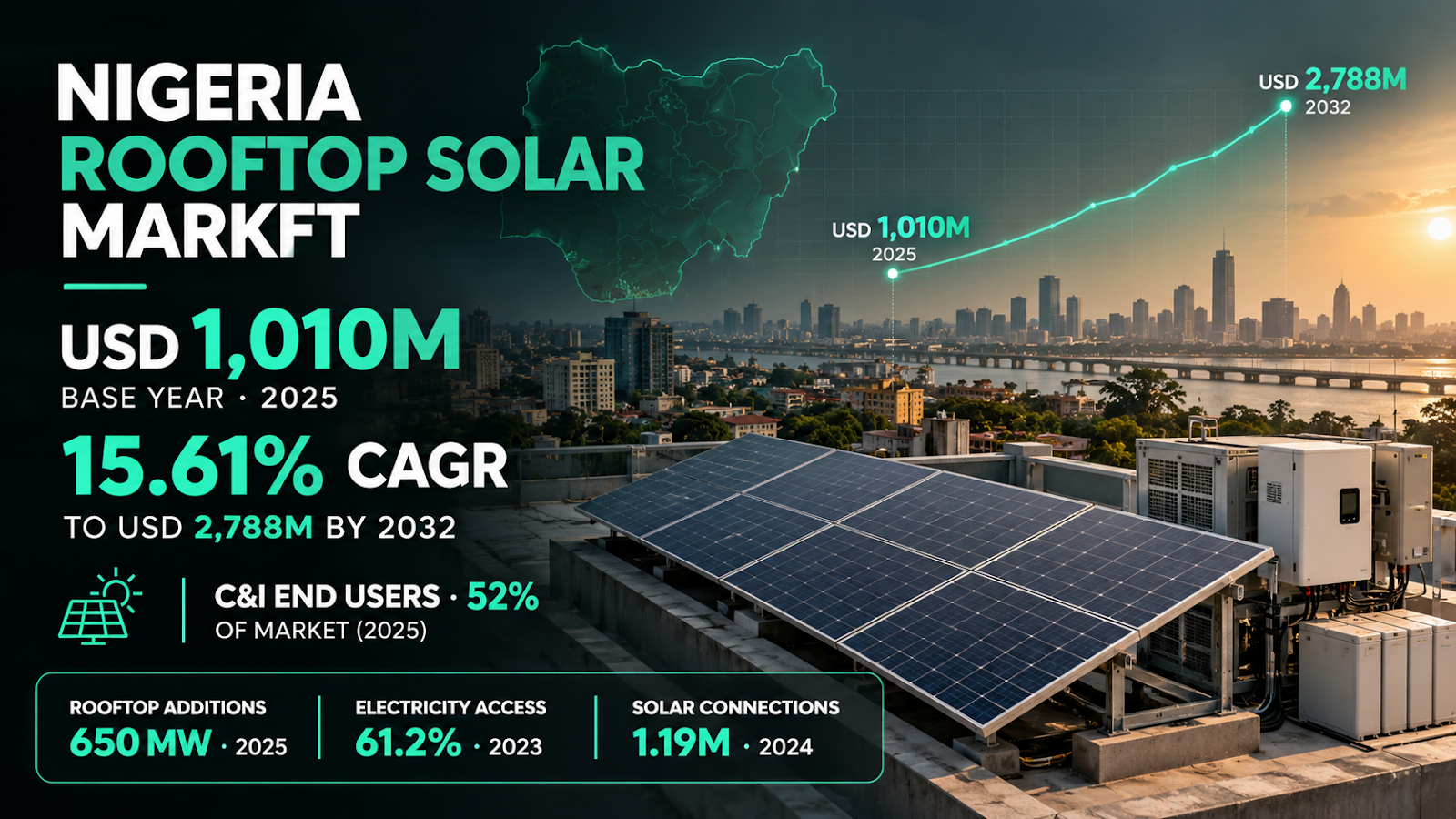
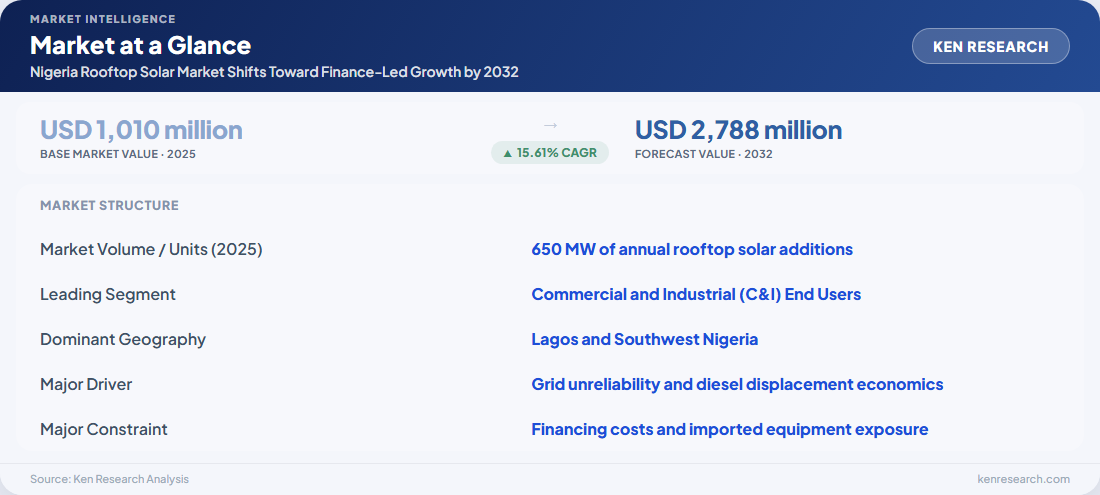
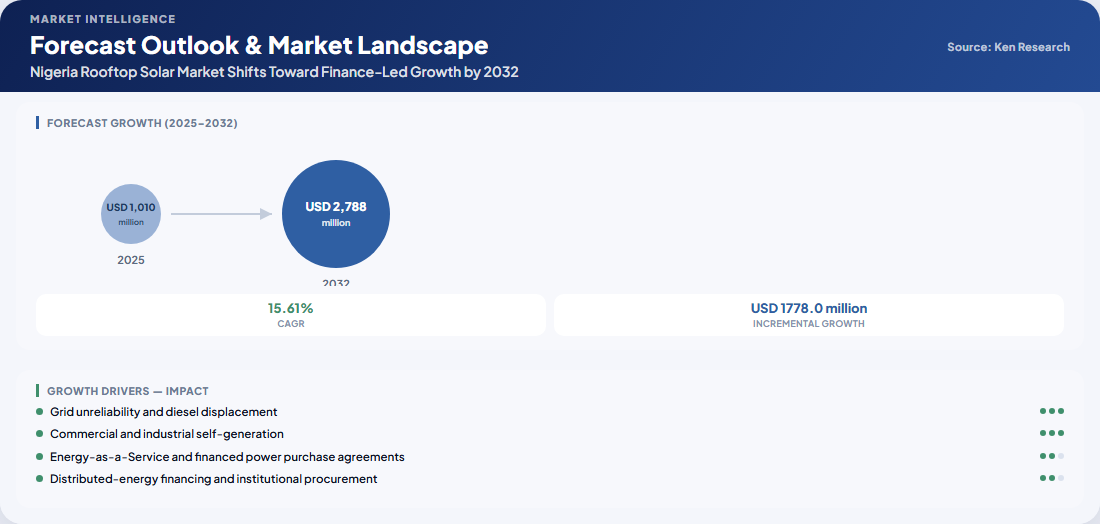
Nigeria’s rooftop solar market is moving beyond equipment sales toward financed, service-led electricity supply, with commercial and industrial customers central to this transition. The August 2026 Ken Research market assessment estimates a base value of USD 1,010 million in 2025, rising to USD 2,788 million by 2032, at a forecast CAGR of 15.61%. These are proprietary market estimates, not government-reported market totals. The commercial question is whether developers can turn rising installations into profitable, financeable portfolios rather than compete primarily on hardware price.
The underlying shift reflects businesses seeking more dependable electricity, lower exposure to diesel costs and greater control over operating expenditure. This creates opportunities for power purchase agreements (PPAs), Energy-as-a-Service and long-term maintenance, while affordability, foreign-exchange volatility and expensive financing can undermine project returns. Household and small-business deployment provides a related demand signal through the Nigeria Solar Home Systems and PAYGo Energy Market, where financing and collection capabilities also influence adoption. The rooftop opportunity therefore depends on converting electricity insecurity into contracts that customers can afford and providers can finance.
How large is Nigeria’s rooftop solar market, and what changes by 2032?
Nigeria’s rooftop solar market is projected to expand substantially through 2032, supported by rising deployment and a shift toward larger commercial installations. Ken Research’s modeled annual rooftop additions increase from 650 MW in 2025 to 2,125 MW in 2032, a volume trajectory that outpaces the value contribution of hardware alone. This distinction matters because falling installed-system prices can support wider adoption while reducing the margin available to equipment-only sellers.
- USD 1.55/W in 2025: The modeled weighted installed PV price establishes a baseline for project budgeting; developers should track total installed cost rather than module prices alone.
- USD 1.31/W by 2032: The forecast price decline implies greater price competition and a need to earn revenue through financing, installation quality, monitoring and maintenance.
- MW additions versus market value: Physical deployment can grow faster than revenue when system prices decline, making capacity sold and lifetime service revenue important complementary performance measures.
The decision implication is to evaluate the market through a two-part lens: deployment growth and revenue quality. Larger projects can improve installation productivity and spread customer-acquisition costs across more capacity, but they also require stronger underwriting and working capital. The next question is why Nigerian customers are willing to adopt rooftop systems despite these financing demands.
Why is commercial and industrial solar driving Nigeria’s rooftop demand?
Commercial and industrial customers are a central demand segment because unreliable grid supply and diesel dependence create direct operating costs that rooftop solar can help reduce. Banks, hospitals, manufacturers, educational institutions and retail operators can evaluate projects against avoided fuel consumption, outage exposure and electricity expenditure. For these buyers, solar is not simply a sustainability purchase: its commercial case rests on dependable supply and a measurable reduction in the cost or disruption of power.
Procurement models are changing alongside the technology. Customers able to fund systems outright may prefer ownership, while organizations preserving capital for core operations can consider PPAs or service-based contracts. The broader Nigeria Off-Grid Solar and Mini-Grid Solutions Market provides context for the role of decentralized power in addressing reliability and access constraints. Rooftop developers can use this wider distributed-energy ecosystem to develop partnerships, but commercial projects still require site-specific load analysis and credible customer payment capacity.
- Daytime electricity demand: Businesses with substantial daytime loads can use generated power directly, improving the potential value of each installed kilowatt.
- Diesel displacement: Buyers should compare solar output against actual generator fuel, maintenance and operating costs, rather than assume every unit of generation delivers equal savings.
- Multi-site procurement: Retail chains, banks and other distributed organizations can standardize technical specifications and maintenance across facilities, reducing duplication in project development.
Which rooftop solar customers and business models matter most in Nigeria?
Commercial and industrial end users lead the market’s commercial opportunity, while residential and institutional projects broaden the addressable customer base. Ken Research identifies Lagos and the Southwest as the dominant geographic hub, reflecting concentrated business activity and demand for more dependable electricity. This does not mean every attractive project sits in the same region: viable site economics depend on consumption patterns, roof suitability, local operating conditions and the buyer’s ability to pay.
Ownership structure can be as important as customer type because it determines who supplies capital, carries performance risk and collects revenue. A direct purchase transfers the initial investment to the customer, whereas a PPA or Energy-as-a-Service arrangement can place financing and system operation with the provider. The Nigeria Off-Grid Solar and Rural Electrification Market offers adjacent context on distributed electricity delivery, although its wider market scope should not be confused with rooftop-specific estimates.
How do Nigeria’s rooftop solar competitors win, and what threatens margins?
Nigeria’s rooftop solar competition includes Daystar Power, Starsight Energy, Rensource Energy, Arnergy and Lumos Nigeria, among other participants. Their presence does not establish a verified market-share ranking, so competitive strength is better assessed through service capability, project execution, customer financing and operating reliability. Providers that can manage a system beyond installation may develop longer customer relationships, while companies relying mainly on equipment resale remain more exposed to price competition.
Don’t miss the next research examines where value will accumulate shift. Ken Research continuously publishes new market intelligence, forecasts and industry analysis. Add Ken Research as a Preferred Source on Google to discover more of our research when your next market question comes up.
Execution also depends on technical compliance and project quality. The Nigerian Electricity Management Services Agency’s renewable-energy certification guidelines set out competency requirements for renewable-energy installation practitioners, including solar PV systems and associated electrical equipment. Developers should account for installation standards, safe commissioning and maintenance capability in contractor selection, because low initial pricing can be outweighed by faults, downtime or expensive remedial work.
- Financing access: Developers with suitable local-currency funding and credible credit assessment can structure contracts around customers’ cash flow and reduce dependence on upfront purchases.
- Service delivery: Monitoring, preventive maintenance and timely fault response protect generation performance and help sustain recurring revenue after commissioning.
- Imported equipment exposure: Currency movements, procurement delays and inventory financing can erode project margins when equipment costs change between quotation and installation.
What will determine Nigeria’s rooftop solar outlook through 2032?
Nigeria’s rooftop solar market is positioned for continued expansion, but achieving the forecast depends on more than increasing installations. The decisive conditions are affordable long-term finance, reliable project delivery and customer contracts that translate avoided power costs into sustainable payments. Lower equipment prices can widen adoption, yet financing costs, foreign-exchange pressure and weak customer affordability can delay projects or make otherwise attractive systems commercially unviable.
For investors, developers and procurement teams, the priority is to test each opportunity against actual load profiles, customer credit, financing terms and lifetime operating costs before scaling deployment. The strongest position is likely to belong to providers that combine sound project economics with reliable installation and long-term service, rather than those competing on panel prices alone. For detailed segmentation, competitive coverage and forecast assumptions, explore the Nigeria Rooftop Solar Market report from Ken Research.


Comments
Post a Comment