Belgium Freight Forwarding Market: Growth Shifts Toward Multimodal and Digital Services
Belgium's Freight Forwarding Market Is Becoming a Test of Coordination, Not Just Capacity: Ken Research Examines the Next Phase
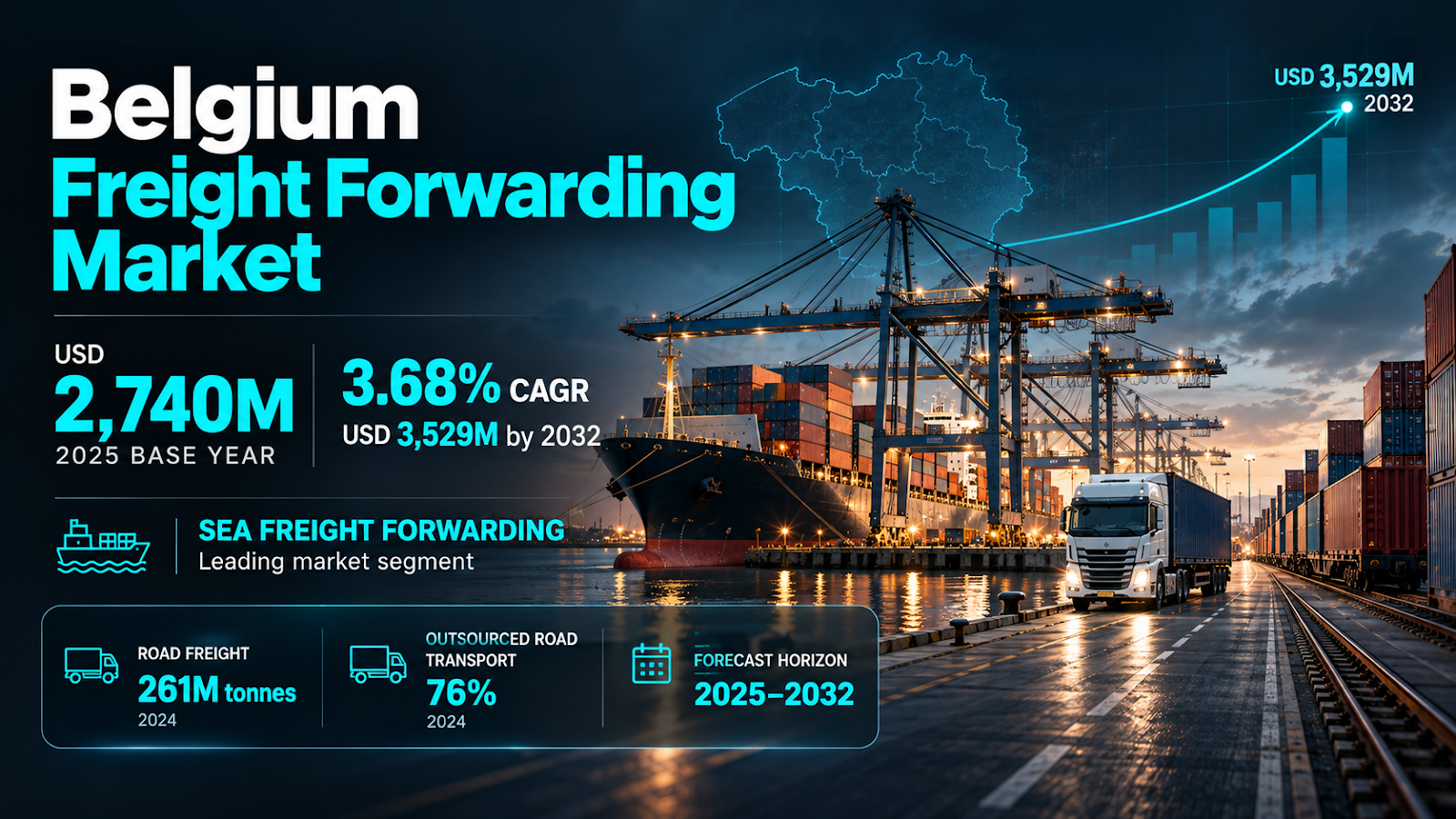
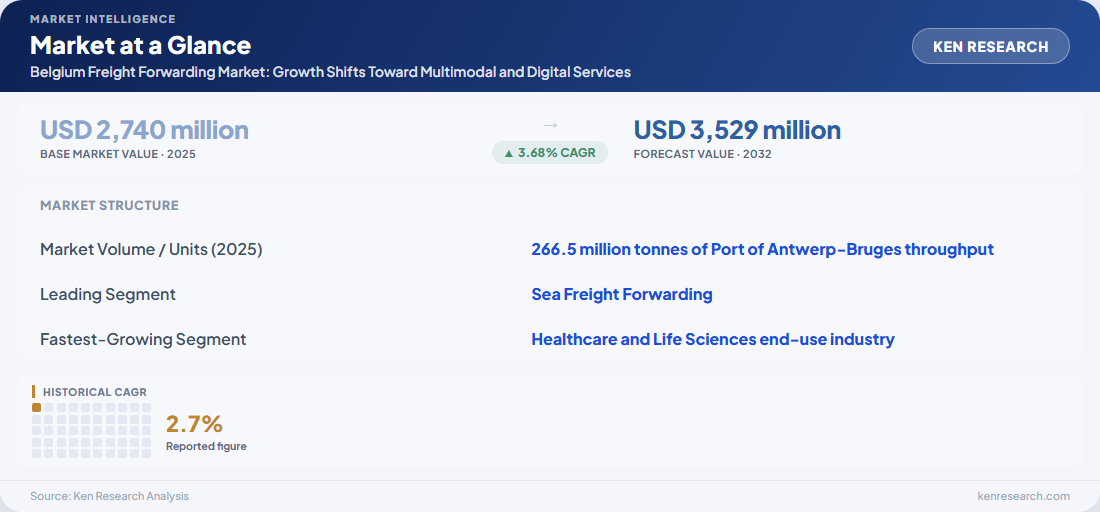
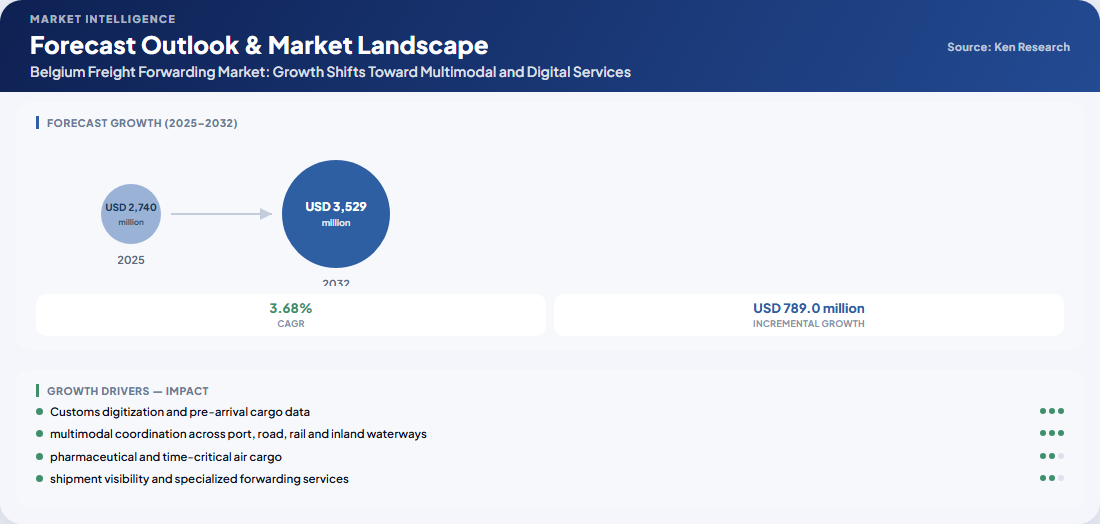
Belgium's freight forwarding market is entering a more service-intensive phase, with growth increasingly linked to customs expertise, multimodal routing and specialized cargo handling rather than physical freight volumes alone. The August 2026 assessment by Ken Research estimates the market at USD 2,740 million in 2025, rising to USD 3,529 million by 2032, representing a forecast CAGR of 3.68%. These proprietary estimates describe forwarding-service revenue, providing a commercial view of the sector beyond headline transport volumes.
The central change is that Belgium's gateway advantage increasingly depends on how effectively operators connect ocean freight, road haulage, air cargo, customs and inland distribution into a reliable service. The 2026 Europe Freight Forwarding Market provides broader context for the importance of digital documentation and multimodal coordination across the region. However, congestion, industrial weakness and freight-rate normalization can still compress margins, meaning additional revenue will not automatically translate into stronger profitability.
How Large Is Belgium's Freight Forwarding Market, and What Drives Its Growth?
Belgium's freight forwarding market combines moderate forecast expansion with a dense international logistics network, making service productivity more important than headline growth alone. Ken Research estimates historical CAGR at 2.70% for 2020–2025, followed by a faster projected pace through 2032. The acceleration indicates an expectation of stronger forwarding-service demand, although it does not imply equivalent growth in cargo tonnage or carrier revenue.
- USD 789 million: The difference between the forecast market value and the 2025 base is a calculated nominal increment, not a separately published market statistic; providers should assess whether new services can capture this additional value profitably.
- 3.40%: Estimated market growth in 2025 followed slower expansion in the preceding two years, suggesting recovery but not immunity to the European freight cycle.
- 2025–2032: The forecast period gives investors and logistics buyers a medium-term planning horizon for technology, carrier procurement and specialist-service investment rather than a guarantee of annual growth.
The commercial distinction is between moving more cargo and earning more from coordinating each shipment. Forwarders that improve consolidation, customs accuracy and exception management can potentially increase service value without relying exclusively on rising freight volumes. This makes the composition of cargo flows and the economics of individual gateways the next questions for market participants.
Why Do Antwerp-Bruges and Belgium's Air Cargo Hubs Matter?
Belgium's forwarding advantage comes from the interaction of seaport access, cross-border road networks, inland waterways and air cargo rather than any single transport mode. The Port of Antwerp-Bruges handled 266.5 million tonnes of cargo in 2025, according to the market assessment, anchoring ocean forwarding and hinterland distribution. Yet total port throughput weakened, showing that infrastructure scale creates opportunity without eliminating disruption or demand risk.
Official Belgian statistics provide an important counterpoint to the market forecast: 261 million tonnes of goods were transported by road using Belgian-registered vehicles in 2024, down 5.5% year on year. International road transport increased 3.5%, while domestic volumes declined. These figures measure physical transport activity, not forwarding-market revenue, but they illustrate why cross-border coordination can remain attractive even when aggregate freight indicators are uneven. Statbel's road freight statistics help buyers distinguish underlying traffic conditions from commercial forecasts.
- 266.5 million tonnes: Port throughput demonstrates the scale of the maritime gateway, supporting demand for customs, container consolidation and inland delivery coordination.
- 156 million tonnes: Estimated Belgian inland-waterway freight in 2025 indicates a substantial physical transport base, although weaker activity makes barge utilization and schedule reliability important commercial tests.
- Approximately 2.12 million tonnes: Combined Brussels and Liège airport cargo in 2025 highlights the relevance of air forwarding for time-sensitive and high-value shipments, where reliability and specialized handling can matter more than lowest-price transport.
The implication is a gateway-diversification strategy: operators should combine maritime scale with flexible air and inland routing instead of treating each mode as an isolated product. This approach can help manage disruption, but it requires enough network visibility and carrier access to switch routes without undermining customer commitments. The next competitive question is which services and buyers can support that additional coordination cost.
Which Customers and Freight Forwarding Segments Offer the Best Opportunities?
Sea freight forwarding remains the leading transport segment in Belgium, while healthcare and life sciences is identified in the market assessment as an attractive growth segment. The commercial opportunity is not simply greater cargo throughput: pharmaceutical, temperature-sensitive and time-critical shipments can require tighter documentation, monitoring and exception handling. These requirements make specialized service capability a potential differentiator, although the available published segment information does not establish a verified revenue share for each category.
Buyer priorities also vary by shipment complexity. Large multinational shippers often need coordinated customs, carrier procurement and cross-border visibility, while smaller businesses may value dependable execution and simpler pricing. On the supply side, Luxembourg's logistics market offers useful neighbouring-market context for the importance of cross-border connectivity and specialized air-cargo services. Belgium's own opportunity, however, depends on its distinct port and airport network, not on transferring another country's growth assumptions directly.
For procurement teams, the useful comparison is total shipment performance rather than the quoted transport rate alone. Buyers should evaluate delivery reliability, customs-data accuracy, contingency routing and the cost of delays alongside price. Forwarders that can demonstrate these outcomes have a stronger basis for specialist contracts, leading directly to the capabilities that determine competitive positioning.
How Are Competition and Customs Compliance Reshaping Belgian Forwarding?
Belgium's freight forwarding market includes international networks such as DHL Global Forwarding, DSV, Kuehne+Nagel and GEODIS, alongside local specialists. The available market information does not support a reliable ranking by market share, so these companies should be treated as an unranked participant set. Competition turns on carrier procurement, network coverage, customs execution, sector expertise and technology integration, with scale helping larger operators spread systems costs across more shipments.
Don’t miss the next ken research examines the next phase shift. Ken Research continuously publishes new market intelligence, forecasts and industry analysis. Add Ken Research as a Preferred Source on Google to discover more of our research when your next market question comes up.
Customs digitization makes data quality a commercial capability rather than merely an administrative task. The European Commission states that the EU's Import Control System 2 became operational across all transport modes, including road and rail, from 1 September 2025, subject to limited national derogations. Operators must submit advance security data and maintain appropriate IT processes. The European Commission's ICS2 guidance explains the system's requirements and preparation process.
For Belgian operators, this creates a practical divide between businesses able to integrate shipment, customs and customer data and those dependent on manual hand-offs. Larger networks may benefit from investment capacity, but smaller specialists can compete through sector knowledge, responsive service and carefully selected technology partnerships. A related technology perspective appears in the Germany Digital Freight Forwarding Platforms Market, where digital coordination is relevant to shipment visibility and operating efficiency. The decisive question is whether technology reduces errors and cost per shipment enough to justify its implementation and maintenance.
Is Belgium's Freight Forwarding Forecast Achievable Through 2032?
Belgium's forecast points toward a larger forwarding-services market by 2032, supported by gateway connectivity, customs complexity and specialized cargo demand, but delivery depends on profitable execution rather than growth alone. The principal upside conditions are resilient international trade, effective multimodal alternatives and stronger demand for high-value forwarding services. The main downside risks are weak European industrial activity, port disruption, volatile freight rates and compliance costs that cannot be passed through to customers.
Executives should monitor shipment-level gross profit, customs exception rates, carrier utilization, gateway reliability and the share of revenue generated by specialized services. These indicators help distinguish durable service-led growth from temporary price or volume effects. For investors, procurement leaders and logistics operators assessing market entry, capacity planning or competitive strategy, the Belgium Freight Forwarding Market report provides the detailed segmentation, competitive coverage and forecast assumptions needed to evaluate the opportunity.


Comments
Post a Comment