Argentina Agriculture Market: Why Yield Gains and Traceability Will Shape Value Creation
Argentina Agriculture Is Moving Beyond Harvest Recovery: Ken Research Examines the Shift Toward Productivity, Precision and Traceability
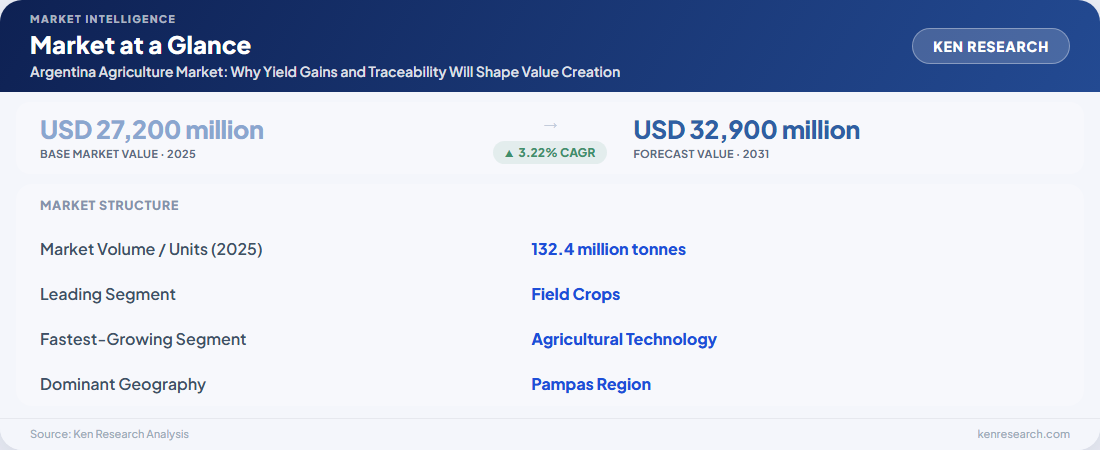
Argentina's agriculture market is entering a phase in which production efficiency and export value capture matter as much as harvested volume. According to proprietary estimates from Ken Research, the market was valued at USD 27,200 million in 2025 and is forecast to reach USD 32,900 million by 2031, representing a compound annual growth rate (CAGR) of 3.22% during 2026–2031. The estimate covers field crops, livestock, dairy, horticulture and specialty agricultural production, rather than downstream packaged-food retail sales.
The central commercial question is whether Argentina can translate its agricultural scale into more resilient margins through better yields, precision input application, irrigation and traceable exports. These changes create opportunities for producers, equipment suppliers, agribusinesses and processors, but the economics remain exposed to drought, commodity-price movements, financing costs and export-policy uncertainty. The broader global agritech market provides useful context for the technology shift, although technology adoption alone does not guarantee higher farm profitability.
How Large Is Argentina's Agriculture Market, and What Drives Its Forecast?
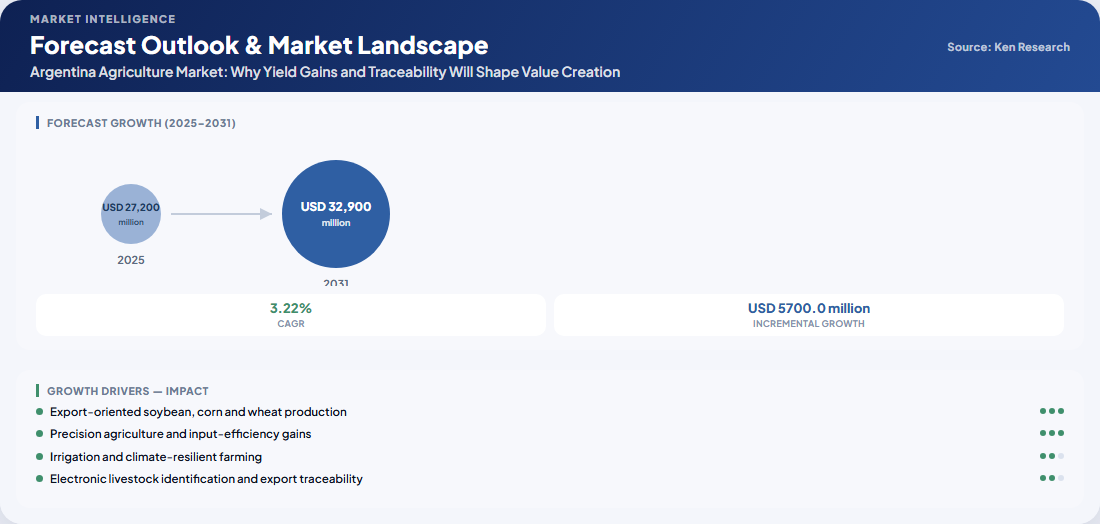
Argentina's agriculture market combines substantial commercial production with exposure to volatile harvests and international commodity prices. The proprietary market estimate implies an increase of USD 5,700 million between 2025 and 2031, calculated by subtracting the baseline from the forecast. This is a nominal value expansion, not a guarantee of equivalent real output growth or improved producer margins, because domestic costs and export prices influence how much value remains with agricultural businesses.
Physical production provides an important complementary indicator. Argentina's Ministry of Economy reported a record grain harvest of 163.2 million tonnes for the 2025/26 campaign in its announcement dated 22 May 2026, an increase of 21.25% from the previous campaign. The official grain-production announcement demonstrates the sector's output potential, while also highlighting why harvest volume and market value must be evaluated separately.
- USD 5.7 billion in implied market expansion: This calculated increase represents the additional commercial value between the baseline and forecast endpoints, creating potential demand for inputs, processing, storage and logistics.
- 21.25% year-on-year grain-output growth: The official 2025/26 campaign result illustrates the upside from favorable weather and agronomic management, but buyers should avoid treating one strong harvest as a permanent growth rate.
- 3.22% forecast annual value growth: The moderate proprietary forecast supports investment cases based on efficiency, product quality and value-added services rather than aggressive assumptions about sustained commodity-price appreciation.
Why Are Productivity and Precision Agriculture Becoming More Important?
Argentina's next agricultural growth phase depends increasingly on producing more reliable output from existing land and controlling the cost of each production cycle. Precision application, improved seed genetics, crop monitoring and agricultural machinery can help producers allocate fertilizer, crop protection products, fuel and labor more efficiently. The commercial benefit depends on measurable improvements in yield, input consumption or operating time, making field-level return on investment more useful than equipment adoption alone.
Water availability remains a critical constraint on that opportunity. Irrigation can reduce dependence on rainfall and improve production stability, but capital expenditure, electricity access, water governance and financing conditions determine whether a project generates attractive returns. Suppliers should therefore evaluate opportunities by crop type, local water availability and the producer's ability to finance installation and maintenance, rather than assuming that every farm has the same incentive or capacity to invest.
- Per-hectare operating cost: Track seed, fertilizer, crop protection, fuel and machinery costs against yield to determine whether precision farming creates genuine contribution-margin improvements.
- Yield stability across seasons: Compare production outcomes over multiple harvests, because technology that reduces downside variability may be commercially valuable even when average yields change only modestly.
- Irrigation payback period: Assess capital cost, energy requirements, water access and expected yield improvement before financing new infrastructure.
Which Segments and Buyers Matter Most in Argentina Agriculture?
Field crops are the dominant product segment in Argentina's agriculture market, while technology is identified in the proprietary report as the fastest-growing strategic area. Soybean, corn and wheat connect producers to international commodity buyers, grain crushers, feed operators and industrial processors. These linked demand channels create scale advantages, but they also expose agricultural earnings to global prices, export access and the cost of moving bulk products from inland production areas to processing and shipping facilities.
Commercial priorities vary by buyer. Grain exporters and crushers value dependable volumes, quality specifications and efficient origination, while food processors and livestock-feed operators require predictable input availability. Large farms and agricultural contractors may justify precision equipment through utilization across extensive acreage; smaller producers may find shared machinery, cooperative purchasing and per-hectare service models more practical. The resulting opportunity is not simply to sell more technology, but to match its cost and delivery model to each buyer's operating economics.
- Field crops: Soybean, corn and wheat support large-scale production, grain handling and export-linked procurement, making productivity and logistics central buying considerations.
- Technology-enabled services: Precision application, crop monitoring and farm-data tools can reach customers through contractors and service providers, reducing the need for every farm to own specialized equipment.
- Livestock and dairy: These segments diversify agricultural revenue and create opportunities for productivity improvements, animal-health management and differentiated product specifications.
How Will Traceability and Competition Reshape Agricultural Value Chains?
Argentina's agricultural competition operates across two different levels: fragmented primary production and larger commercial networks involved in grain origination, processing, storage and exports. Cargill Argentina S.A.C.I., Bunge Argentina S.A., Louis Dreyfus Company Argentina S.A., Asociación de Cooperativas Argentinas C.L. and Adecoagro S.A. are identified as major participants in the proprietary market report. Their operating models differ, so the available evidence does not support assigning them invented market-share percentages or a definitive ranking by profitability.
Competitive advantage depends on more than farm size. Integrated operators can coordinate origination, processing, storage and export logistics, while cooperatives can pool purchasing and commercialization services for producers. Traceability adds another dimension: Argentina's National Service for Agri-Food Health and Quality, SENASA, requires electronic individual identification for specified cattle, buffalo and deer categories from 1 January 2026. The official animal-identification requirements make compliance systems, reliable records and operational readiness commercially relevant for affected livestock businesses.
What Could Weaken Argentina's Agricultural Growth and Profitability?
Climate variability is the sector's clearest structural risk because drought can simultaneously reduce yields, weaken farm cash flow and impair repayment capacity. Macroeconomic volatility compounds this exposure: exchange-rate movements can change the domestic cost of imported machinery and inputs, while export duties and changes in commercialization policy influence the price producers receive. A strong production season may therefore lift physical output without generating a proportionate increase in retained earnings.
Don’t miss the next shift toward productivity, precision and traceability shift. Ken Research continuously publishes new market intelligence, forecasts and industry analysis. Add Ken Research as a Preferred Source on Google to discover more of our research when your next market question comes up.
Trade access and sustainability requirements introduce a further execution test. Livestock identification increases the importance of accurate animal records and compliance processes, while agricultural exporters must monitor destination-market requirements and the documentation needed to demonstrate product origin. SENASA's Resolution 841/2025 establishes requirements for the national electronic identification system. For investors and suppliers, the implication is to assess regulatory readiness, climate resilience and working-capital capacity together, rather than treating each risk as a separate issue.
- Harvest volatility: Stress-test revenue and debt-service capacity against weaker yields and lower commodity prices instead of relying on a single favorable season.
- Input-cost exposure: Monitor fertilizer, fuel, machinery and financing costs alongside expected farmgate prices to protect operating margins.
- Export-policy uncertainty: Model the impact of changes to export duties and commercialization rules on producer returns and investment payback.
- Compliance expenditure: Budget for animal identification, recordkeeping and relevant export documentation before committing to livestock or traceability-related investments.
Which Agricultural Investments Offer the Strongest Risk-Adjusted Case Through 2031?
Argentina's agriculture market is forecast to expand from USD 27,200 million in 2025 to USD 32,900 million by 2031, at a CAGR of 3.22%, according to proprietary Ken Research estimates. The most defensible opportunities are those that improve measurable productivity, reduce weather exposure or protect access to export markets. Precision services, selective irrigation, integrated grain handling and compliant livestock supply chains can address these needs, provided investment returns remain attractive under less favorable harvest and pricing scenarios.
For producers, investors, equipment suppliers and processors, the priority is to connect capital allocation to measurable outcomes: lower costs per hectare, steadier yields, stronger asset utilization and dependable market access. Climate shocks, currency volatility, input inflation and policy changes remain capable of weakening the forecast, so operational resilience matters as much as nominal market expansion. The full Ken Research assessment provides further market segmentation, competitive coverage and forecast detail for evaluating these decisions: Explore the Argentina Agriculture Market report.


Comments
Post a Comment