Thailand Generic Pharmaceuticals Market Outlook 2024-2030: Growth and Players
Thailand Generic Pharmaceuticals Market Outlook 2024-2030: Growth and Players
Executive Summary
Thailand's generic pharmaceuticals market is anchored by universal health coverage and cost-containment. Affordable-medicine demand, aging demographics, and public procurement are pushing the market from USD 2.0 Billion in 2024 toward roughly USD 2.7 Billion by 2030, with unbranded generics dominant in public hospitals.
Key Market Velocity Data
- Current Market Value: USD 2.0 Billion in 2024
- Projected Market Value: around USD 2.7 Billion by 2030
- CAGR: about 5% during 2025 to 2030
- Market Share: generics are about 42% of the USD 8.9 Billion Thai pharma market
- Primary Growth Catalyst: universal coverage and cost-containment
What Is Driving Demand in the Thailand Generics Market?
Demand is policy and affordability led. About 60% of the population relies on generics, the National Health Security Office allocated THB 220 Billion for generic procurement, and total healthcare expenditure is projected near THB 1.6 trillion, up about 7%. Hospital generic procurement is expected to rise about 22% as aging and chronic disease climb.
Chronic non-communicable diseases such as diabetes, cardiovascular conditions, and cancer keep refill volumes structurally high across public hospitals, and sustained government support for local production continues to deepen the domestic generics base.
- Affordability: about 60% of the population depends on generics for treatment.
- Public procurement: the NHSO allocated THB 220 Billion for generic purchasing.
- Spending growth: healthcare expenditure heads toward THB 1.6 trillion, up about 7%.
- Hospital demand: hospital generic procurement is set to rise about 22%.
How Do Universal Coverage and Regulation Shape the Market?
Public health policy is the engine. The National Health Security Act of 2002 underpins the Universal Coverage Scheme, and the National List of Essential Medicines, guided by health technology assessment, sets the reimbursement list across all three public schemes (Thai FDA). The Thai FDA registers all NLEM medicines. Cost-effectiveness analysis decides which drugs enter the reimbursement list, favoring proven, low-cost generics.
Procurement rules favor scale and compliance. NLEM inclusion drives volume, while the Thai FDA is expected to process more than 1,600 applications, and in 2024 the NHSB approved fresh budget for high-cost essential medicines. These frameworks reward GMP-certified, registered generic producers over informal suppliers. Local manufacturing incentives are nudging supply away from imported finished drugs toward domestic capacity.
Which Companies Are Shaping the Competitive Landscape?
State and local producers lead supply. The Government Pharmaceutical Organization anchors essential-medicine manufacturing and, through Siam Bioscience, produces biologics, while Berlin Pharmaceutical Industry, founded in 1932, leads branded generics in chronic disease. Thai Nakorn Patana, founded in 1979, holds a strong consumer-health position. State backing gives the GPO unmatched scale and priority in essential-medicine supply contracts, and royal-backed Siam Bioscience extends this into advanced biologics.
Private manufacturers round out the field. Siam Pharmaceutical, Greater Pharma, Mega Lifesciences, and Biolab compete across oral solids and OTC. The advantage sits with producers that combine NLEM listings, GMP compliance, and public-hospital supply relationships. Contract manufacturing for multinationals adds an export-oriented revenue layer.
What Does This Mean for B2B Decision-Makers?
For manufacturers, distributors, and investors, Thailand is a stable, policy-driven generics market where NLEM access decides volume. With the market moving from USD 2.0 Billion toward roughly USD 2.7 Billion by 2030 at about 5% CAGR, growth is steady, but reimbursement listing and GMP compliance define winners. Pricing pressure under universal coverage rewards low-cost, high-volume producers with efficient supply chains and disciplined tender execution.
- For manufacturers: prioritize NLEM listings, which gate the THB 220 Billion procurement pool.
- For distributors: build public-hospital supply as procurement rises about 22%.
- For investors: back biosimilar capacity, the small but fastest-growing segment.
- For exporters: leverage Thai GMP to supply ASEAN public-health systems.
Which Segments and Formulations Lead the Thailand Generics Market?
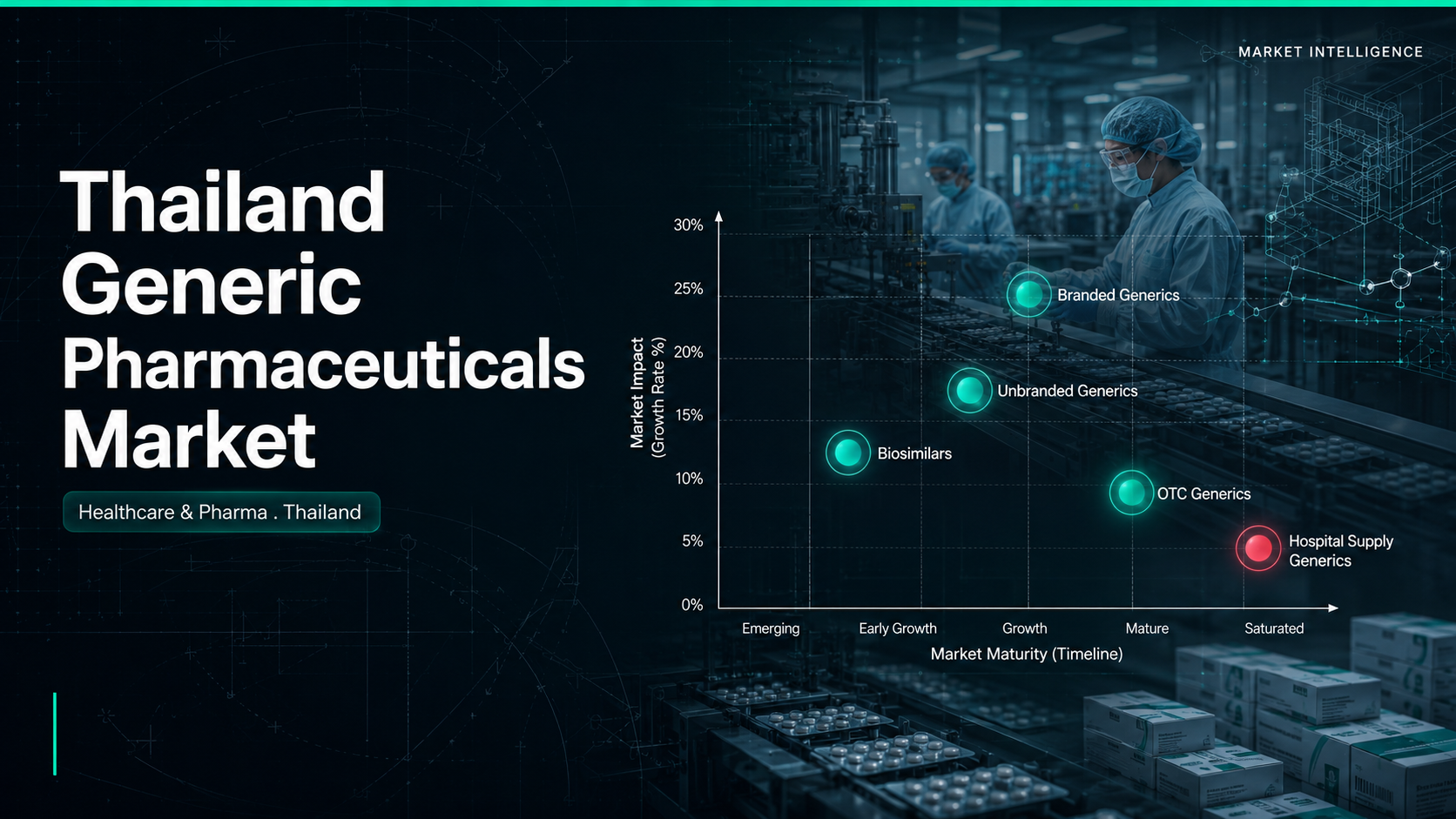
Segment economics favor unbranded generics and oral solids. Unbranded INN generics dominate public and hospital settings, oral solids lead by formulation, and biosimilars form a small but fast-growing frontier. Branded generics retain pull in private retail, while OTC generics serve self-medication demand. Biosimilars are the strategic prize as patents on costly biologics expire over the decade.
- Product mix: unbranded INN generics dominate, while biosimilars grow fastest off a small base.
- Formulation: oral solids such as tablets and capsules lead production.
- Channel: public hospitals anchor volume, with private retail driving branded generics.
Ken Research Strategic Outlook
The decisive lever in Thai generics is universal coverage plus reimbursement listing, not branding. As the NLEM and NHSO procurement expand, margin will migrate toward GMP-certified producers with strong public-hospital ties and emerging biosimilar capacity. Expect the GPO and established locals like Berlin and Thai Nakorn Patana to lead, pushing the market toward USD 2.7 Billion by 2030. Biosimilar localization through Siam Bioscience is the next competitive frontier for Thai pharma over the coming decade.
Data Source and Full Analysis
For deeper segment-level analysis, access the full Ken Research report here: Thailand Generic Pharmaceuticals Market Report


Comments
Post a Comment