Singapore Smart Mobility MaaS Platforms Market Outlook 2024-2030: Growth and Forecast
Executive Summary
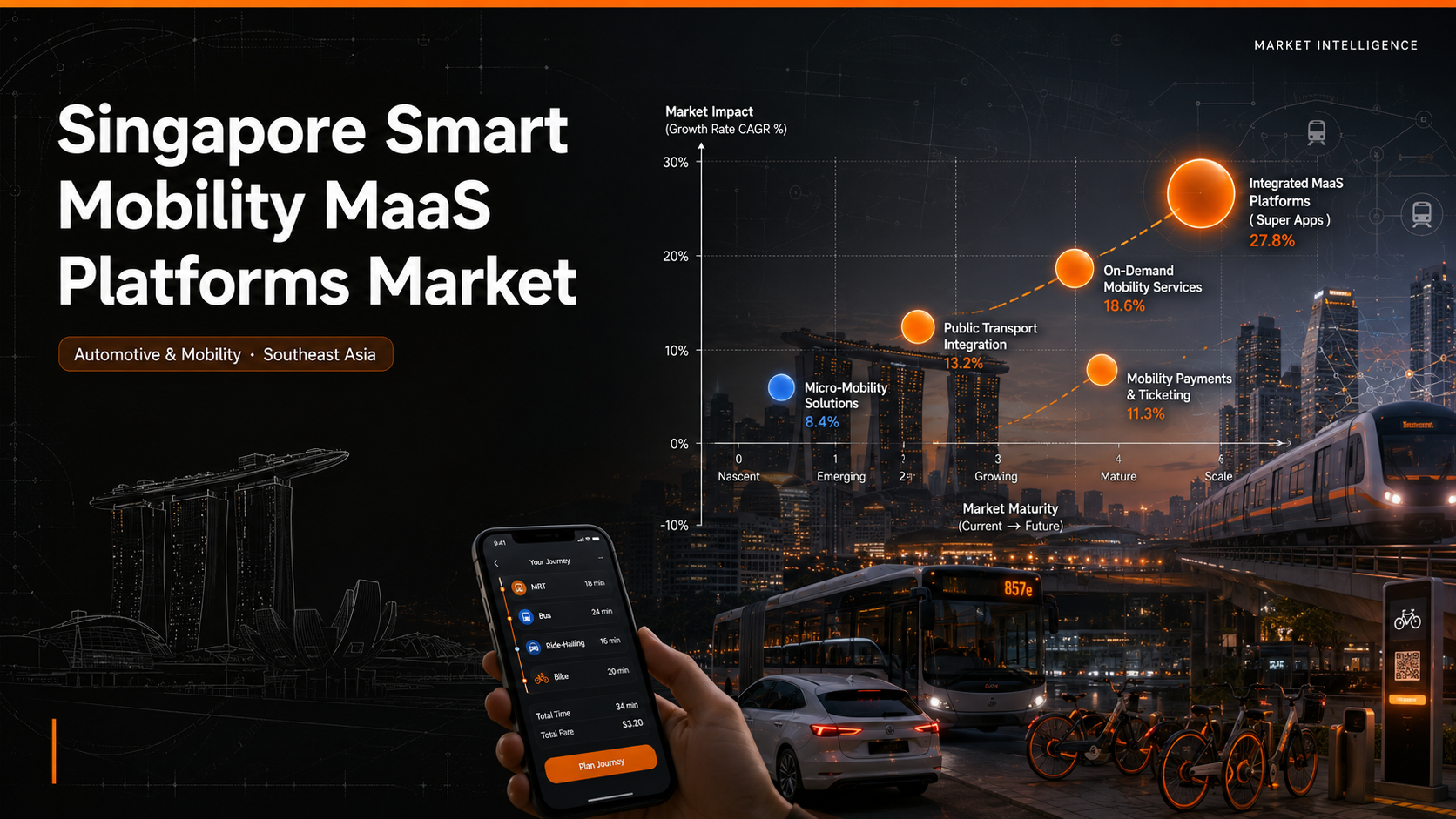
Singapore's smart mobility and MaaS market reached USD 1.1 billion in 2024, and it is government-orchestrated by design. The lesson so far: super-apps and state-backed integration win, while standalone MaaS aggregators have struggled.
Key Market Velocity Data
- Current Market Value: USD 1.1 billion in 2024
- Projected Market Value: approximately USD 3.3 billion by 2030
- CAGR: about 20% during 2025 to 2030
- Dominant Segment: ride-hailing and micro-mobility, consumer-led
- Primary Growth Catalyst: government smart-city policy, super-app integration, and sustainability
What Is Driving the Market?
Policy is the prime mover. The market sits at USD 1.1 billion in 2024 and is projected toward USD 3.3 billion by 2030 at about 20% CAGR. Singapore targets 75% public transport usage and 60,000 EV charging stations, anchoring demand for integrated mobility. Few cities combine this density, wealth, and policy push, making Singapore a global MaaS test bed. Results here often set the template for the wider Southeast Asian region.
State funding amplifies it. A SGD 1 billion smart-city allocation and the wider Smart Mobility 2030 plan, budgeted near USD 1.7 billion, fund autonomous transit and digital platforms. Urbanization toward 5.7 million residents and a 36% carbon-reduction goal push multimodal adoption. Autonomous shuttles and buses are a key pillar of that public spending.
- Policy anchor: a 75% public transport target and 60,000 EV charging stations drive integration
- Public funding: SGD 1 billion plus Smart Mobility 2030's USD 1.7 billion fund platforms and autonomy
- Sustainability: a 36% carbon-reduction goal pushes shared and electric mobility
- Density: 5.7 million urban residents make multimodal MaaS economically viable
Which Entities Are Shaping the Market?
Super-apps and operators dominate. Grab leads with ride-hailing, trip planning, and subscriptions, alongside Gojek and ComfortDelGro's CDG Zig. Micro-mobility players Anywheel, Beam Mobility, and SG Bike, plus TransitLink, round out a USD 1.1 billion market growing near 20% CAGR. Each operator competes for the same commuter wallet across modes.
Pure aggregators have struggled. Zipster, launched by mobilityX in 2019, closed within two years, showing standalone MaaS is hard to sustain. Value is consolidating around super-apps and government-backed integration, with ride-hailing and micro-mobility the fastest-adopting segments across the USD 1.1 billion market. The economics favor platforms with existing scale and payment relationships. Incumbent transit operators also hold the trust and ridership that pure aggregators lack.
The Land Transport Authority orchestrates the ecosystem. Its MaaS Sandbox Programme, launched in 2023, and the Land Transport Master Plan 2040 set the integration framework, targets, and standards. With a 75% public transport goal, the state actively shapes which platforms scale. This top-down coordination is rare globally and de-risks integration for partners.
How Do Modes and Users Split?
Modes and users concentrate demand. Ride-hailing and micro-mobility lead adoption, ahead of car-sharing, public-transport integration, and fleet telematics. Individual consumers dominate end-use, followed by corporates and government agencies, across the USD 1.1 billion market in 2024. MaaS aggregator platforms remain the hardest segment to monetize. Subscription bundling across modes is the model regulators most want to see succeed.
- By mode: ride-hailing and micro-mobility lead, with car-sharing and transit integration following
- By user: individual consumers dominate, while corporates and government agencies follow
- By model: super-app integration outperforms standalone MaaS aggregators
- By driver: government targets and EV infrastructure anchor long-term demand
What Does This Mean for B2B Decision-Makers?
Integrate or partner, do not go standalone. The USD 1.1 billion market grows about 20%, but Zipster's failure shows pure aggregators struggle. Winners embed mobility into super-apps or align with LTA's integration framework rather than competing alone. Data sharing and interoperability with public transit are non-negotiable for scale.
Government alignment is the moat. The LTA Sandbox and LTMP 2040 favor platforms that fit national targets like 75% public transport use and the EV charging buildout. Partnerships with transport operators beat purely private plays. Trust and reliability, not just app design, decide which platform commuters keep using. Capital is flowing to integrated, policy-aligned ecosystems rather than standalone apps.
- For mobility platforms: integrate with super-apps or LTA frameworks rather than launching a standalone MaaS app alone
- For transport operators: partner on data and ticketing to capture the 75% public transport target
- For investors: back super-app and government-aligned models over standalone aggregators for durable returns
- For EV and infrastructure firms: tie offerings to the 60,000-station charging buildout and fleet electrification
Ken Research Strategic Outlook
Ken Research sees Singapore MaaS as a government-orchestrated, integration-led market, not an open aggregator race. The next phase rewards super-apps and operators aligned with LTA targets, while standalone MaaS continues to struggle. Expect the USD 1.1 billion market to roughly triple toward USD 3.3 billion by 2030 as policy, autonomy, and electrification converge.
Data Source and Full Analysis
For deeper segment-level analysis, access the full Ken Research report here: Singapore Smart Mobility MaaS Platforms Market Report


Comments
Post a Comment