Russia Nutritional Dietary Supplements Outlook 2024-2030: Growth Drivers and B2B Entry
Russia Nutritional Dietary Supplements Outlook 2024-2030: Growth Drivers and B2B Entry
Executive Summary
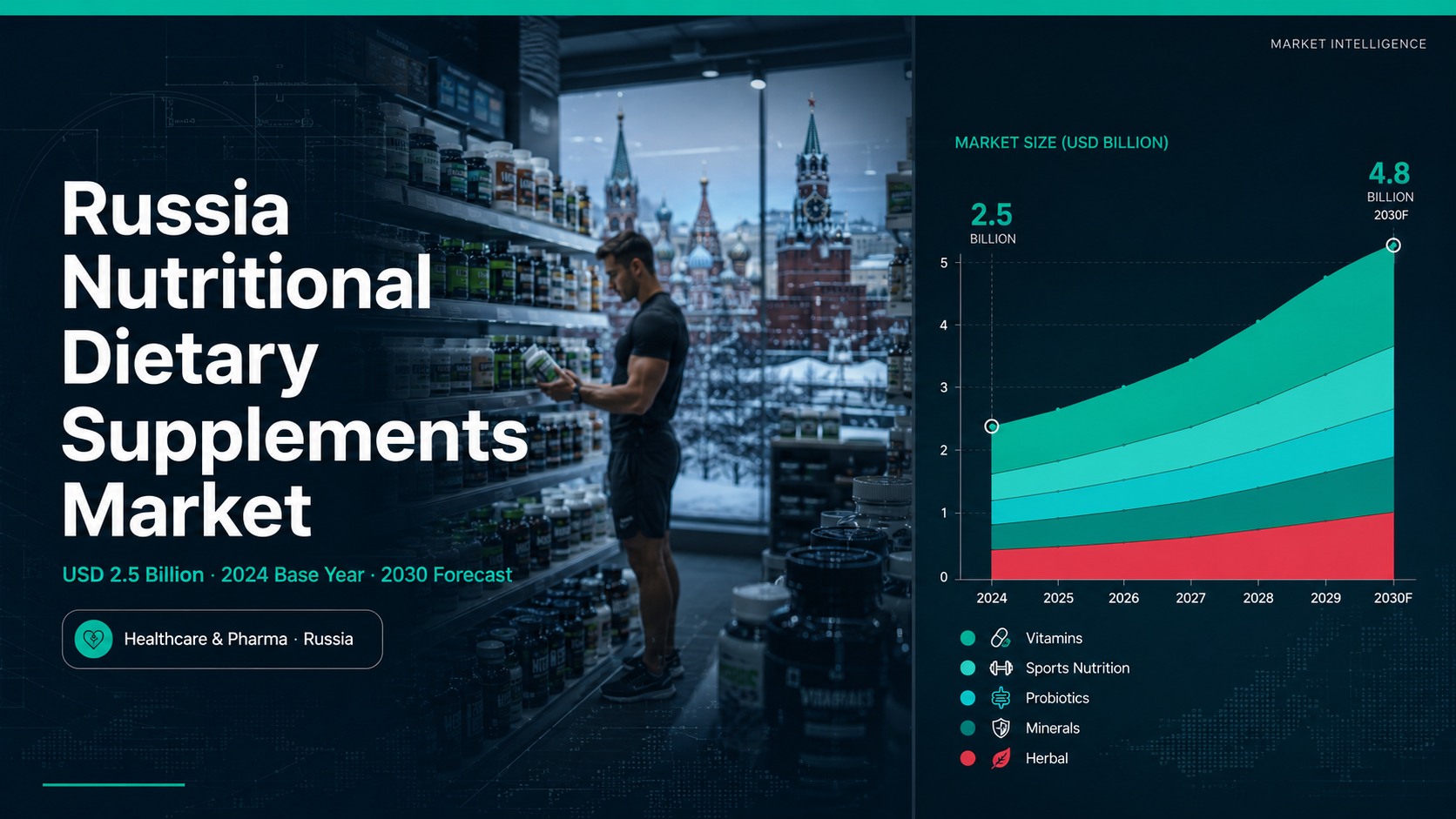
Russia nutritional and dietary supplements market, valued at USD 2.5 billion in 2024, grows at 5.64-12.15% CAGR through 2030. E-commerce driving 40% year-on-year channel growth, organic and natural supplements at 35% annually, and 200+ new regulations per year are reshaping Russia's supplements competitive landscape dominated by 1,500+ active brands.
Key Market Velocity Data
- Current Market Value: USD 2.5 billion in 2024
- Projected Market Value: USD 3.33 billion by 2032 (Data Bridge)
- CAGR: 5.64-12.15% during 2024-2032 (varies by segment scope)
- Fastest Growing Channel: E-commerce at 40% year-on-year growth
- Fastest Growing Segment: Organic and natural supplements at 35% annually
What Is Driving the Market?
Russia's supplements market is driven by three structural forces that remain intact despite geopolitical and macroeconomic headwinds. First, health consciousness shift post-COVID: preventive healthcare adoption has accelerated sharply among Russian urban consumers, with vitamins and immune-support supplements becoming mainstream self-medication categories. The government's promotion of healthy lifestyle programs under the National Health Project has embedded supplement awareness across age groups beyond the core sports nutrition demographic. Second, e-commerce channel democratization: Russia's supplement e-commerce channel has grown at 40% year-on-year, driven by Wildberries, Ozon, and Apteka.ru enabling brand discovery in regions beyond Moscow, St. Petersburg, and Kazan. Digital platforms now represent the primary discovery and purchase channel for herbal supplements, probiotics, and personalized nutrition products. Third, import substitution creating domestic brand opportunity: Russia's 2022 international sanctions environment has significantly reduced the shelf presence of Western supplement brands, creating market share gains for domestic producers including Pharmstandard, Evalar, and Siberian Health while simultaneously creating regulatory complexity with 200+ new regulations per year governing supplement safety, labeling, and import controls.
- Preventive health adoption: Post-COVID wellness shift driving vitamins, immunity, and probiotics demand across all age groups
- E-commerce surge: 40% year-on-year channel growth via Wildberries and Ozon reaching beyond top-3 cities
- Import substitution: Western brand exit creating market share opportunity for domestic producers and compliant non-sanctioned international brands
Which Entities Are Shaping the Market?
Pharmstandard is Russia's largest pharmaceutical and supplement company, with extensive manufacturing capacity across vitamins, minerals, and immune-support categories, and strong pharmacy retail distribution across Russia's 70,000+ registered pharmacies. Evalar, based in Altai region, is Russia's leading herbal supplement brand, dominating the phytotherapy category with over 500 product SKUs and strong brand loyalty in Russia's traditional medicine consumer segment. ZAO Siberian Health operates a direct sales model with significant online and catalogue-based distribution, competing in vitamins, adaptogens, and beauty supplements. Herbalife Russia and Amway Russia represent the remaining international MLM supplement layer. Natur Product produces licensed international supplement formulations under Russian manufacturing compliance. The regulatory framework is administered by Rospotrebnadzor (Federal Service for Surveillance on Consumer Rights Protection) and the Ministry of Health of the Russian Federation, which govern supplement registration, safety testing mandates (2023), labeling requirements, and the import control regime that has tightened significantly since 2022, requiring Russian state registration for all supplement products sold through domestic retail or e-commerce channels.
What Does This Mean for B2B Decision-Makers?
Russia's supplement market requires careful B2B entry assessment given the current geopolitical context, but domestic producers and non-Western international players face significant opportunity in the import substitution environment.
- For domestic Russian supplement manufacturers and ingredient suppliers: Pharmstandard, Evalar, and regional producers are actively sourcing raw material substitutes for previously EU and US-sourced vitamin precursors and botanical extracts; Indian, Chinese, and domestic ingredient suppliers with Rospotrebnadzor-compliant quality documentation have immediate procurement access at premium pricing
- For e-commerce and digital marketing platforms: The 40% year-on-year growth of supplement e-commerce on Wildberries and Ozon creates demand for product listing optimization, digital advertising, and fulfillment logistics services tailored to supplement category compliance requirements including age verification and health claim moderation
- For personalized nutrition and health technology ventures: Russia's 50% projected growth in personalized supplements and growing digital health integration represent an early-stage opportunity for diagnostic-to-supplement platforms targeting Moscow and St. Petersburg's health-conscious urban segments who currently lack the AI-driven personalization tools available in Western markets
Ken Research Strategic Outlook
Russia's supplements market is bifurcating between a regulated, pharmacy-anchored mainstream channel dominated by Pharmstandard and Evalar, and a rapidly growing e-commerce channel where domestic and international brands compete on price, digital marketing, and personalization. The import substitution dynamic has durably shifted the competitive landscape, creating a 3-5 year window for domestic manufacturers and non-Western international players to establish brand positions before Western competitors regain market access. The highest-margin opportunity is in organic and natural supplements growing at 35% annually, probiotics growing at 7.12% CAGR, and personalized nutrition platforms where supply is severely limited relative to growing urban consumer demand. B2B entrants with Rospotrebnadzor-compliant supply chains and e-commerce-native brand strategies are best positioned to capture share in this USD 2.5 billion market through 2030.
Data Source and Full Analysis
For deeper segment-level analysis, access the full Ken Research report here: Russia Nutritional Dietary Supplements Market Report


Comments
Post a Comment