Qatar Hyaluronic Acid Dermal Fillers Market Outlook 2024-2030: Growth and Players
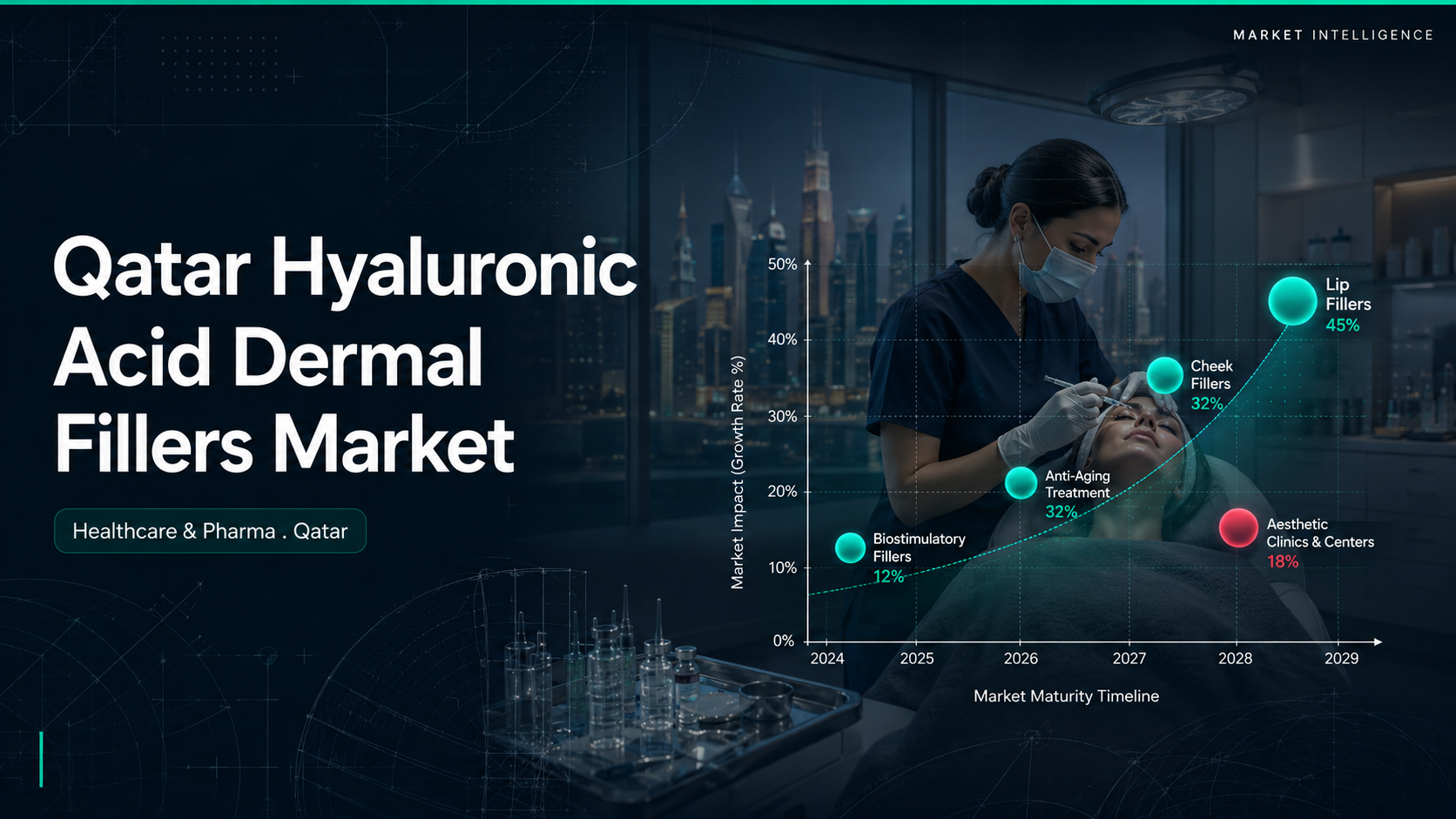
Qatar Hyaluronic Acid Dermal Fillers Market Outlook 2024-2030: Growth and Players
Executive Summary
Qatar's hyaluronic acid dermal fillers market is scaling on demand for non-surgical aesthetics. Rising awareness, clinic expansion, and high disposable income in Doha are pushing the market from USD 160 Million in 2024 toward roughly USD 210 Million by 2030, with HA fillers the dominant format.
Key Market Velocity Data
- Current Market Value: USD 160 Million in 2024
- Projected Market Value: around USD 210 Million by 2030
- CAGR: about 4.6% during 2025 to 2030
- Largest Type: hyaluronic acid fillers, with aesthetic clinics leading
- Primary Growth Catalyst: non-surgical aesthetics demand and clinic expansion
What Is Driving Demand in the Qatar Dermal Fillers Market?
Demand is shifting decisively to non-surgical options. Non-surgical aesthetic procedures rose about 30% year over year, more than 60% of the population is now familiar with dermal fillers, and the number of aesthetic clinics is expected to grow about 20%. Injectable fillers already make up close to 90% of Qatar's aesthetic dermatology market. Medical tourism and a young, affluent expatriate population add a steady stream of first-time and repeat aesthetic patients across Doha.
- Procedure shift: non-surgical aesthetic procedures rose about 30% year over year.
- Awareness: over 60% of the population is now familiar with dermal fillers.
- Clinic growth: aesthetic clinic numbers are expected to expand about 20%.
- Category weight: injectables form close to 90% of aesthetic dermatology demand.
How Does Regulation Shape the Market?
Regulation is tightening around safety and credentials. The Ministry of Public Health, through the Qatar Council for Healthcare Practitioners, enforces Medical Practice Law No. 25 of 2023, which requires all cosmetic procedures to be performed by licensed practitioners in accredited facilities (Qatar Ministry of Public Health). Practitioner privileges are granted only after recognized training. This formalization is professionalizing a segment once run loosely, raising the credibility of accredited providers.
Compliance is a real barrier. About 42% of new product applications faced compliance delays, slowing launches and favoring established, registered brands. These standards push demand toward accredited clinics and clinically validated HA filler lines over informal providers. Accreditation lifts fixed costs but protects patient safety and builds long-term trust, giving registered brands a clear compliance advantage.
Which Companies Are Shaping the Competitive Landscape?
Global aesthetic majors lead the field. Allergan, part of AbbVie, anchors the market with its Juvederm line on HYLACROSS technology, while Galderma's Restylane uses NASHA and XpresHAn platforms. Teoxane brings its Resilient Hyaluronic Acid technology, and Merz and Sinclair hold strong premium positions. Brand reputation, longevity data, and clinical safety records drive practitioner preference at the premium end.
Challengers add pricing pressure. Revance, Ipsen, Hugel, Medytox, and Revanesse compete across tiers, while Chinese producers such as IMEIK, Bloomage, and Haohai erode price points with high-volume capacity. Differentiation runs on technology, longevity, and clinical safety rather than price alone. Distribution partnerships with accredited clinics now decide which brands reach Qatari patients at scale.
What Does This Mean for B2B Decision-Makers?
For brands, clinics, and investors, Qatar is a small but high-value, premiumizing market, and regulatory credentials now decide access. With the market moving from USD 160 Million toward roughly USD 210 Million by 2030 at about 4.6% CAGR, growth is steady, but licensing and brand trust define winners. Patient trust built on safety records and visible results is the real moat in this market.
- For brands: prioritize registration early, as 42% of applications faced compliance delays.
- For clinics: secure QCHP privileges to capture the 30% rise in procedures.
- For investors: back accredited clinic chains as the clinic base grows about 20%.
- For distributors: stock clinically validated HA lines that dominate the 90% injectable share.
Which Segments and Applications Lead the Qatar Fillers Market?
Segment economics favor cross-linked HA fillers in clinic settings. Hyaluronic acid fillers dominate over other materials, cross-linked formulations lead on longevity, and applications span facial contouring, lip enhancement, and wrinkle reduction. Aesthetic clinics drive volume, with hospitals and dermatology centers serving complex cases. Lip and cheek augmentation lead demand among younger patients, while wrinkle reduction anchors older cohorts.
- Material mix: HA fillers dominate, with cross-linked formulations leading on durability.
- Applications: facial contouring, lip enhancement, and wrinkle reduction anchor demand.
- Channel: aesthetic clinics lead, while hospitals and derm centers handle complex cases.
Ken Research Strategic Outlook
The decisive lever in Qatar fillers is regulation plus brand trust, not volume. As Medical Practice Law No. 25 enforcement tightens, margin will migrate toward registered, clinically validated brands and accredited clinics, while informal providers are squeezed out. Expect Allergan, Galderma, and Teoxane to defend the premium tier as the market approaches USD 210 Million by 2030. Premiumization and repeat treatment cycles will sustain steady, defensible growth.
Data Source and Full Analysis
For deeper segment-level analysis, access the full Ken Research report here: Qatar Hyaluronic Acid Dermal Fillers Market Report


Comments
Post a Comment