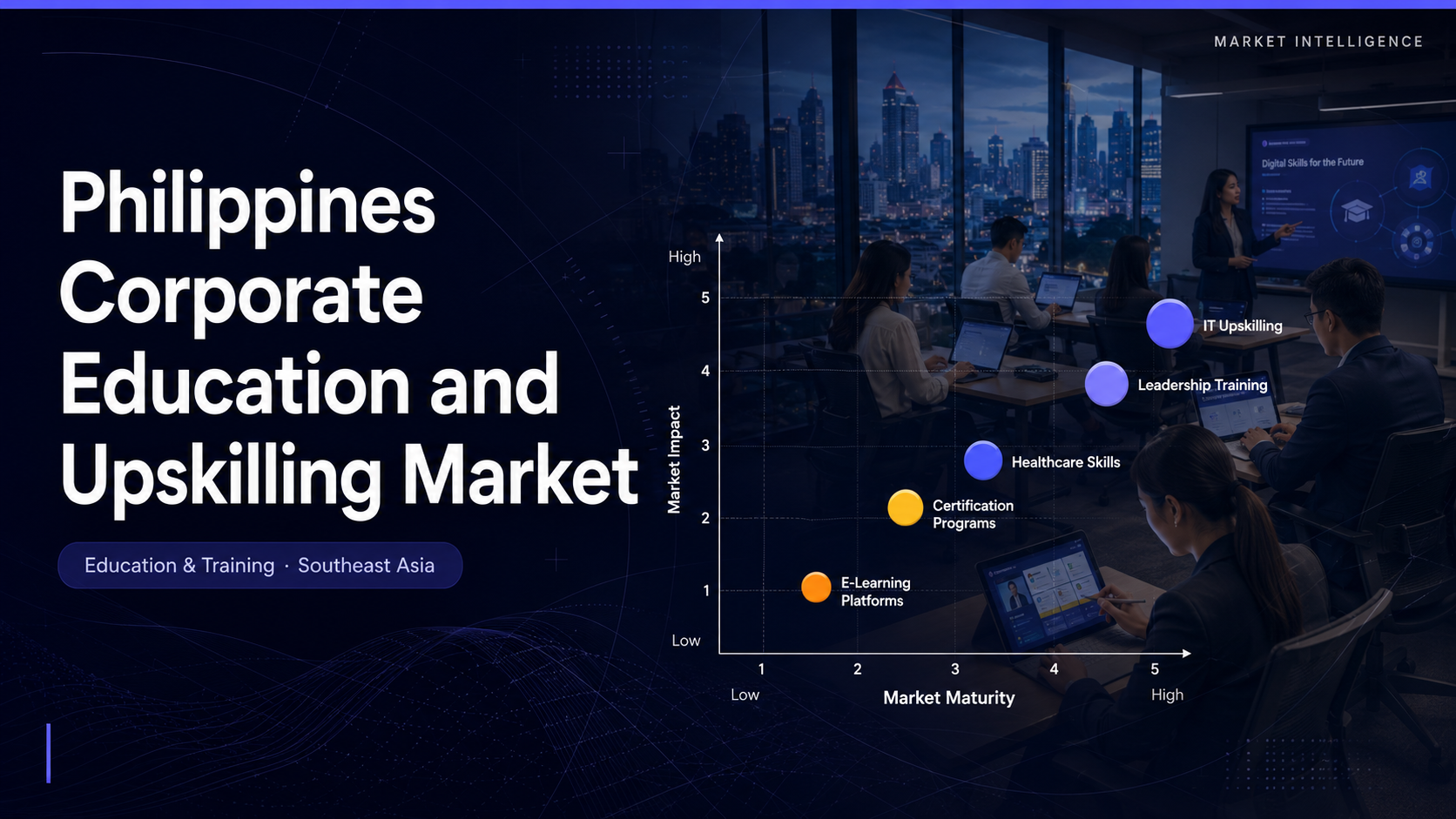
Philippines Corporate Education Market Surges to USD 1.2B | Ken Research
The biggest skills gap in the Philippines workforce is not English fluency or BPO headcount: it is competency-based learning infrastructure that scales beyond TESDA classrooms into the enterprise corridor. As per Ken Research market modelling, the Philippines Corporate Education and Upskilling Market is valued at USD 1.2 billion in 2026, driven by digital transformation demand and government-backed skills mandates reshaping enterprise training budgets. The full competitive landscape, forecasts, and segment analysis are available in the Philippines Corporate Education and Upskilling Market Report.
This analysis draws on data from market modelling by Ken Research, TESDA policy disclosures, DepEd and CHED regulatory frameworks, and independent edtech platform benchmarking.
IT Upskilling Captures 40% of Philippine Corporate Training Spend in 2026
Digital transformation upskilling is rewriting budget allocations across Philippine enterprises. The IT and technology skills segment accounts for approximately 40% of total corporate training expenditure in 2026, outpacing leadership programs and soft-skills modules by a considerable margin. The country reports over 1.5 million unfilled tech vacancies, creating a talent pipeline development crisis that corporations solve by internalizing training. For operators benchmarking platform consolidation dynamics in adjacent markets, the Philippines E-Learning and Corporate Training Market tracks how enterprise adoption drove a 30% increase in platform users over two years.
- IT and Tech Skills: Approximately 40% of corporate training spend, led by Accenture Philippines, IBM Skills Academy, and Microsoft Philippines deploying modular curricula.
- Certification Programs: TESDA-accredited AI fundamentals, RPA, and data analytics certification targets over 600,000 learners in 2026 under the expanded national mandate.
- Digital Delivery: Internet penetration at 73% across 76 million users enables enterprise-scale digital delivery below classroom cost points.
PHP 19 Billion TESDA Scholarship and EBET Act Push TVET Alignment to Enterprises
The Enterprise-Based Education and Training framework under the EBET Act has shifted TVET alignment directly onto corporations. Employers must now register all employee upskilling programs with TESDA, and registered programs qualify for government co-funding that reduces per-head training costs by an estimated 25 to 35%. TESDA enrolled over 5 million learners since 2022, sustained by a PHP 19 billion scholarship program in 2026 covering AI readiness, digital business transformation, and semiconductor skills. For CFOs benchmarking subsidy-blended training models, the India Corporate E-Learning and Upskilling Market shows how analogous frameworks expanded addressable market size by over 18% within two funding cycles.
- EBET Registration: Mandatory TESDA registration effective 2025 formalizes previously untracked informal enterprise training expenditure across all company sizes.
- PHP 1.5 Billion Earmark: Government allocated PHP 1.5 billion for vocational skills development targeting 500,000 individuals under the workforce readiness assessment mandate.
- JMC 2024 Alignment: A Joint Memorandum Circular by DepEd, TESDA, CHED, and DOLE in May 2024 embeds TVET into all Senior High School tracks to close employer-readiness gaps at workforce entry.
Which training segments are capturing the most enterprise budget in the Philippines right now? Download Sample Report to access segment-level data and competitive benchmarking across all training verticals.
Why Is the Philippines Corporate Education Market Outpacing Regional Peers in 2026?
Three structural forces converge: a 73% internet penetration rate enabling scalable digital delivery, government-funded scholarships that de-risk enterprise training investment, and over 76 million internet users creating a digitally reachable workforce at scale. Per the National Technical Education and Skills Development Plan published by TESDA, the 2026 training targets of 650,000 new learners are anchored to future-ready sectors including semiconductors, renewable energy, and electric vehicles. Only 30% of Philippine companies currently access high-quality accredited programs, signaling that the addressable market remains largely untapped at current enterprise penetration levels.
Philippines Corporate Training Outlook to 2030: USD 2 Billion Threshold Within Reach
The talent pipeline development race points toward a market crossing USD 2 billion before 2030, driven by private enterprise demand and expanding scholarship infrastructure. The Digital Education Act of 2023 mandates annual professional development for all accredited educators, seeding instructional capacity renewal. Digital learning platform adoption has shown a 30% user increase through 2026, and workforce readiness assessment requirements under EBET are expected to add 400,000 annual corporate training enrollments by 2028 as ASEAN-qualification alignment opens cross-border certification revenue.
- AI and RPA Expansion: TESDA expanded its 2026 mandate to AI fundamentals and RPA, creating curriculum update cycles across over 3,000 registered training institutions.
- BPO Sector Demand: The BPO industry employs over 1.3 million Filipinos and now drives AI-assisted process training as automation displaces lower-skill tasks.
- ASEAN Recognition: The PQF-ASEAN Qualifications Framework alignment in 2025 enables Philippine certifications to be recognized across ASEAN, expanding the monetizable learner base.
Want segment forecasts, player benchmarking, and EBET policy impact analysis for the Philippines upskilling market? Philippines Corporate Education and Upskilling Market Report delivers full competitive intelligence for market entrants and incumbents.
What Training Providers, Corporations, and Investors Must Do Before the 2027 Window Closes
The EBET mandate, PHP 19 billion scholarship expansion, and TESDA target of 650,000 new learners in 2026 create a two-year positioning window that narrows as competition consolidates around accredited platforms by 2027. Three stakeholder groups face distinct strategic imperatives.
- Training Providers: Accelerate TESDA accreditation for AI, RPA, and data analytics curricula to capture the PHP 19 billion scholarship pipeline before incumbent platforms lock enterprise agreements by 2027.
- Corporations: Register upskilling programs under EBET to access the estimated 25 to 35% cost reduction from government co-funding, cutting training capex without reducing headcount development coverage.
- Investors: The USD 1.2 billion base at 30% enterprise penetration signals a 3x growth runway before saturation in mid-market segments, making early-stage platform stakes highly capital-efficient.
Conclusion
The Philippines corporate education market has shifted from a cost-center exercise to a structural growth lever anchored by government mandate and digital infrastructure. The convergence of a PHP 19 billion scholarship program, a 73% internet-penetrated workforce, and the EBET co-funding framework creates a demand floor no economic softening will remove. For providers and investors, the key question is which TESDA-certified segment to anchor before 2027 consolidation begins.
Frequently Asked Questions
Q1: What is the size of the Philippines Corporate Education and Upskilling Market?
The Philippines Corporate Education and Upskilling Market is valued at USD 1.2 billion in 2026 per Ken Research modelling. TESDA enrolled over 5 million learners since 2022, reflecting rapid expansion across IT, healthcare, manufacturing, and BPO training verticals.
Q2: Who are the key players in the Philippines corporate training market?
Leading players include TESDA, Accenture Philippines, IBM Skills Academy, Microsoft Philippines, Globe Telecom, PLDT, Coursera, Udemy, and LinkedIn Learning. TESDA-accredited providers collectively target over 600,000 learners in 2026 across regulated tech and enterprise skills programs.
Q3: Which segment leads the Philippines Corporate Education Market in 2026?
IT and digital transformation upskilling leads with approximately 40% of corporate training spend per industry analysis, driven by AI fundamentals, RPA, and data analytics certifications. Operators tracking comparable dynamics across ASEAN can benchmark against the Vietnam E-Learning and Digital Upskilling Market, where similar platform dynamics reshape enterprise training spend.
Q4: What is driving growth in the Philippines corporate training market?
Three drivers converge: a PHP 19 billion TESDA scholarship program in 2026, the EBET mandate requiring employer-registered upskilling, and over 1.5 million unfilled tech vacancies forcing enterprises to build rather than buy talent. Internet penetration at 73% enables affordable digital-first delivery at national scale.
Q5: How does the EBET framework affect corporate training investment?
The EBET Act requires corporations to register all employee upskilling programs with TESDA for quality assurance. Registered programs qualify for government co-funding, reducing per-head training costs by an estimated 25 to 35%. Over 3,000 registered training institutions are accredited to deliver EBET-aligned curricula across all Philippine regions.
For the full competitive benchmarking, segment-level forecasts, and regional breakdown, access the Philippines Corporate Education and Upskilling Market Report from Ken Research, a leading market intelligence firm covering education and training across Southeast Asia.


Comments
Post a Comment